
|
You entered: space
 Gamma ray Rain from 3C 279
21.07.2015
If gamma-rays were raindrops a flare from a supermassive black hole might look like this. Not so gently falling on the Fermi Gamma-ray Space Telescope from June 14 to June 16 the gamma-ray photons, with energies up to 50 billion electron volts, originated in active galaxy 3C 279 some 5 billion light-years away.
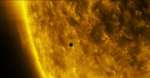 A Mercury Transit Music Video from SDO
10.05.2016
What's that small black dot moving across the Sun? Mercury. Possibly the clearest view of Mercury crossing in front of the Sun earlier this week was from Earth orbit. The Solar Dynamics Observatory obtained an uninterrupted vista recording it not only in optical light but also in bands of ultraviolet light.
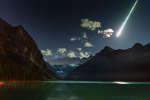 Fireball over Lake Louise
11.10.2021
What makes a meteor a fireball? First of all, everyone agrees that a fireball is an exceptionally bright meteor. Past that, the International Astronomical Union defines a fireball as a meteor brighter than apparent magnitude -4, which corresponds (roughly) to being brighter than any planet -- as well as bright enough to cast a human-noticeable shadow.
 APOD: 2023 August 29 Б Unusual Spiral Galaxy M66 from Webb
28.08.2023
Why isn't spiral galaxy M66 symmetric? Usually, density waves of gas, dust, and newly formed stars circle a spiral galaxy's center and create a nearly symmetric galaxy. The differences between...
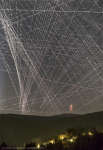 APOD: 2026 April 27 Б Comet R3 PanSTARRS Behind Satellite Trails
26.04.2026
Can you find the comet? Somewhere through this web of satellite trails is Comet C/2025 R3 (PanSTARRS), a bright visitor passing through the inner Solar System. Now, the orbiting satellites themselves only appear as streaks because of the long camera exposure, over 10 minutes in this case.
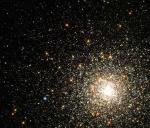 M80: A Dense Globular Cluster
7.07.1999
If our Sun were part of M80, the night sky would glow like a jewel box of bright stars. M80, also known as NGC 6093, is one of about 250 globular clusters that survive in our Galaxy.
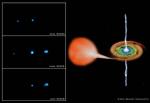 The X Ray Jets of XTE J1550
8.10.2002
The motion of ultra-fast jets shooting out from a candidate black hole star system have now been documented by observations from the orbiting Chandra X-ray Observatory. In 1998, X-ray source XTE J1550-564 underwent a tremendous outburst.
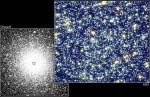 Blue Stagglers in Globular Clusters
3.11.1997
This old dog is doing new tricks. On the left is ancient globular cluster 47 Tucanae which formed many billions of years ago. On the right is a closeup of its dense stellar center by the Hubble Space Telescope, released last week.
 A Spiral Galaxy Gallery
13.03.1998
A progression of beautiful spiral galaxies is illustrated above with three photographs from NASA's Ultraviolet Imaging Telescope (UIT). Flying above the Earth's obscuring layer of atmosphere on the Space Shuttle Columbia during...
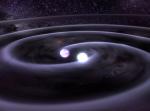 White Dwarf Star Spiral
1.06.2005
About 1,600 light-years away, in a binary star system fondly known as J0806, two dense white dwarf stars orbit each other once every 321 seconds. Interpreting x-ray data from the Chandra Observatory astronomers argue that the stars' already impressively short orbital period is steadily getting shorter as the stars spiral closer together.
|
January February March April May June July August September October |
|||||||||||||||||||||||||||||||||||||||||||||||||