
|
You entered: space
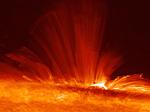 An Active Sunspot Viewed Sideways
2.04.2007
Why are there dark spots on the sun? Although noted for thousands of years, sunspots have been known for decades to be regions of the Sun that are slightly depressed and cooled by the Sun's complex and changing magnetic field.
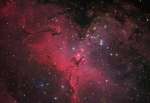 M16 and the Eagle Nebula
19.07.2008
Young star cluster M16 is surrounded by natal clouds of cosmic dust and glowing gas also known as The Eagle Nebula. This beautifully detailed image of the region includes fantastic shapes made famous in well-known Hubble Space Telescope close-ups of the starforming complex.
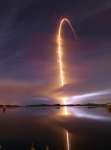 RBSP Night Launch
2.09.2012
This graceful arc traces a Delta rocket climbing through Thursday's early morning skies over Cape Canaveral Air Force Station in Florida, USA. Snug inside the rocket's Centaur upper stage were NASA's twin Radiation Belt Storm Probes (RBSP), now in separate orbits within planet Earth's Van Allen radiation belts.
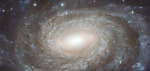 NGC 6384: Spiral Beyond the Stars
6.07.2013
The universe is filled with galaxies. But to see them astronomers must look out beyond the stars of our own galaxy, the Milky Way. This colorful Hubble Space Telescopic portrait features spiral galaxy NGC 6384, about 80 million light-years away in the direction of the constellation Ophiuchus.
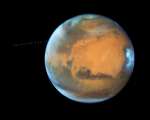 Phobos: Moon over Mars
21.07.2017
A tiny moon with a scary name, Phobos emerges from behind the Red Planet in this timelapse sequence from the Earth-orbiting Hubble Space Telescope. Over 22 minutes the 13 separate exposures were captured near the 2016 closest approach of Mars to planet Earth. Martians have to look to the west to watch Phobos rise, though.
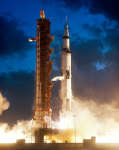 Saturn the Giant
9.11.2019
On May 25, 1961 U.S. president John Kennedy announced the goal of landing astronauts on the Moon by the end of the decade. By November 9, 1967 this Saturn V rocket was ready for launch and the first full test of its capabilities on the Apollo 4 mission.
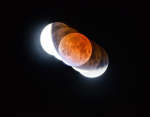 At the Shadow s Edge
25.11.2021
Shaped like a cone tapering into space, the Earth's dark central shadow or umbra has a circular cross-section. It's wider than the Moon at the distance of the Moon's orbit though. But during the lunar eclipse of November 18/19, part of the Moon remained just outside the umbral shadow.
 APOD: 2023 August 6 Б SN 1006: A Supernova Ribbon from Hubble
6.08.2023
What created this unusual space ribbon? The answer: one of the most violent explosions ever witnessed by ancient humans. Back in the year 1006 AD, light reached Earth from a stellar explosion...
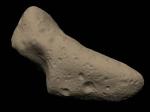 Asteroid Eros Reconstructed
5.06.2001
Orbiting the Sun between Mars and Earth, asteroid 433 Eros was visited by the robot spacecraft NEAR-Shoemaker in 2000 February. Some of the 100,000+ images taken by NEAR of the tumbling space rock have been combined into the above high-resolution composite.
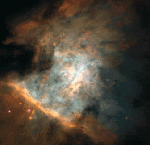 M42: Orion Nebula Mosaic
21.11.1995
The Great Nebula in Orion is one of the most interesting of all astronomical nebulae known. Here fifteen pictures from the Hubble Space Telescope have been merged to show the great expanse and diverse nature of the nebula.
|
January February March April May June July August September October |
|||||||||||||||||||||||||||||||||||||||||||||||||