
|
You entered: HST
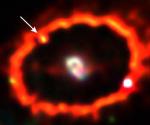 Shocked by Supernova 1987a
17.02.1998
Eleven years ago the brightest supernova of modern times was recorded. Now the expanding debris from this tremendous stellar explosion is seen to be crashing into previously expelled material. The onset of this collision is shown by the arrow in the above picture as the yellow spot on the interior of the ring.
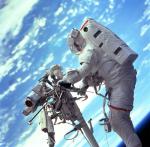 Working in Space
23.05.2004
High above planet Earth, a human helps an ailing machine. The machine, in this potentially touching story, is the Hubble Space Telescope, which is not in the picture. The human is Astronaut Steven L.
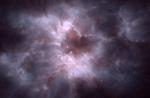 NGC 2440: Cocoon of a New White Dwarf
3.07.1999
Like a butterfly, a white dwarf star begins its life by casting off a cocoon that enclosed its former self. In this analogy, however, the Sun would be a caterpillar and the ejected shell of gas would become the prettiest of all!
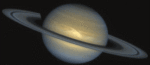 A Storm on Saturn
18.10.1995
The white wisp shown on Saturn's cloud tops is actually a major storm system only discovered in December of 1994. Saturn's clouds are composed of primarily hydrogen and helium, but the storm's white clouds are actually ammonia ice crystals that have frozen upon upheaval to the top of the atmosphere.
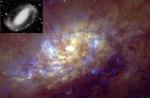 Starbirth in NGC 1808
23.03.1998
The center of galaxy NGC 1808 is bursting with new stars, but why? Being a barred spiral galaxy makes NGC 1808 somewhat similar to our own Milky Way Galaxy. But the disk of NGC 1808 (inset) is quite warped, and its center is unusually bright and blue.
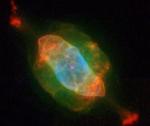 NGC 7009: The Saturn Nebula
30.12.1997
The layers of the Saturn Nebula give a complex picture of how this planetary nebula was created. The above picture, taken in April 1996 and released last week, allows a better understanding of the mysterious process that transformed a low-mass star into a white dwarf star.
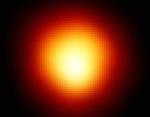 Betelgeuse
19.04.1998
Here is the first direct picture of the surface of a star other than our Sun. Taken by the Hubble Space Telescope in 1995, the atmosphere of Betelgeuse reveals some unexpected features, including a large bright hotspot visible below the center.
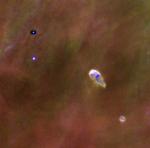 Trapezium: Teardrops in My Skies
28.02.1999
Sometimes the unexpected comes in a familiar shape. In this picture, the seemingly familiar teardrop-shaped object just right of center is actually an unusually situated disk of gas and dust. In fact, the teardrop is about the size of our own Solar System and is racing against time to condense and form planets.
 GRB970228: What's There?
7.04.1997
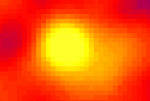
Could this fuzzy blob be the key to the whole gamma-ray burst (GRB) mystery? Astronomers the world over are now scrambling to determine the true nature of the extended emission seen to the lower right of the bright source in the above image.
 A Map of Asteroid Vesta
8.09.1997
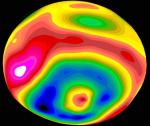
Vesta is a huge rock 500 kilometers across that orbits out past Mars. Last week, the above map of Vesta created using the Hubble Space Telescope was released showing a rugged surface highlighted by a single crater spanning nearly the entire length of the asteroid.
|
January February March April May June July August September October |
|||||||||||||||||||||||||||||||||||||||||||||||||