
|
You entered: HST
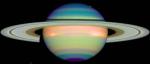 Infrared Saturn
24.07.1999
This delightfully detailed false color image of Saturn was earmarked to celebrate the 8th anniversary of the orbiting Hubble Space Telescope. The picture is a combination of three images taken in January 1998 and shows the lovely ringed planet in reflected infrared light.
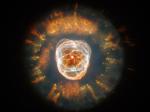 The Eskimo Nebula from Hubble
9.07.2006
In 1787, astronomer William Herschel discovered the Eskimo Nebula. From the ground, NGC 2392 resembles a person's head surrounded by a parka hood. In 2000, the Hubble Space Telescope imaged the Eskimo Nebula. From space, the nebula displays gas clouds so complex they are not fully understood.
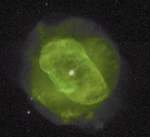 NGC 5882: A Small Planetary Nebula
28.08.1996
Will most stars one day look like this? Pictured above is the planetary nebula NGC 5882, captured by the Hubble Space Telescope. Although planetary nebulae can appear similar to planets like Uranus and Neptune, they are actually gas clouds surrounding stars typically hundreds of light years away.
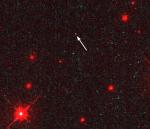 A Lonely Neutron Star
26.09.1997
How massive can a star get without imploding into a black hole? These limits are being tested by the discovery of a lone neutron star in space. Observations by the Hubble Space Telescope released...
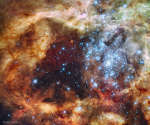 Star Cluster R136 Bursts Out
24.01.2016
In the center of star-forming region 30 Doradus lies a huge cluster containing some of the largest, hottest, and most massive stars known. These stars, known collectively as star cluster R136, were captured in the featured image in visible light by the Wide Field Camera 3 in 2009 peering through the Hubble Space Telescope.
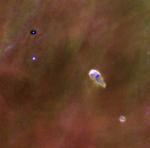 Trapezium: Teardrops in My Skies
16.01.1997
Sometimes the unexpected comes in a familiar shape. In this recently released picture, the seemingly familiar teardrop-shaped object just right of center is actually an unusually situated disk of gas and dust. In fact, the teardrop is about the size of our own Solar System and is racing against time to condense and form planets.
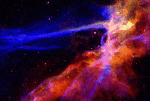 Rampaging Fronts of the Veil Nebula
7.03.1996
A supernova explosion of a high-mass star results in fast moving blast waves. At the front of the waves shown above, ionized gas in the Veil Supernova Remnant rushes out from the explosion, sweeps up material, and breaks up many atoms into constituent ions and electrons.
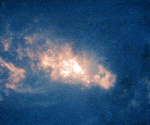 In the Center of Spiral M77
11.09.1996
What is happening in the center of nearby spiral galaxy M77? To find out, astronomers used the Hubble Space Telescope to peer deep into the dusty chaos of this active galactic nucleus in 1994.
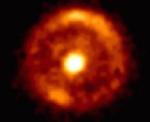 A Bulls Eye Einstein Ring
30.03.1998
Can one galaxy hide behind another? Not in the case of B1938+666. Here the foreground galaxy acts like a huge gravitational lens, pulling the light from the background object around it, keeping it visible.
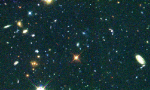 Watch Galaxies Form
5.09.1996
Snips and snails and puppy dog tails, is that what galaxies were made of? In a report released yesterday and soon to be published in Nature, astronomers have imaged an interesting distant patch of sky with the orbiting Hubble Space Telescope.
|
January February March April May June July August September October |
|||||||||||||||||||||||||||||||||||||||||||||||||