
|
You entered: telescope
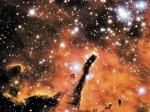 NGC 6823: Cloud Sculpting Star Cluster
4.10.2004
Star cluster NGC 6823 is ready for its close-up. The center of the open cluster, visible on the upper right, formed only about two million years ago and is dominated in brightness by a host of bright young blue stars.
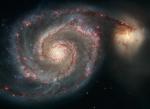 M51: Cosmic Whirlpool
11.11.2006
Follow the handle of the Big Dipper away from the dipper's bowl, until you get to the handle's last bright star. Then, just slide your telescope a little south and west and you might find this stunning pair of interacting galaxies, the 51st entry in Charles Messier's famous catalog.
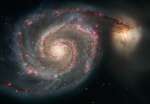 M51: Cosmic Whirlpool
5.01.2008
Follow the handle of the Big Dipper away from the dipper's bowl, until you get to the handle's last bright star. Then, just slide your telescope a little south and west and you might find this stunning pair of interacting galaxies, the 51st entry in Charles Messier's famous catalog.
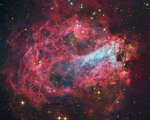 Star Factory Messier 17
27.05.2014
What's happening at the center of this nebula? Sculpted by stellar winds and radiation, the star factory known as Messier 17 lies some 5,500 light-years away in the nebula-rich constellation Sagittarius. At that distance, this degree wide field of view spans almost 100 light-years.
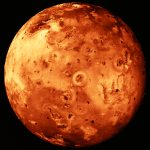 Io: A Volcanic Moon
3.08.1995
In 1610, Galileo turned his telescope to the heavens and discovered that the planet Jupiter had four bright moons. The innermost of these Galilean moons, Io, turned out to be one of the most exotic objects in the solar system.
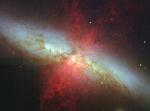 A Superwind from the Cigar Galaxy
4.04.2000
What's lighting up the Cigar Galaxy? M82, as this irregular galaxy is also known, was stirred up by a recent pass near large spiral galaxy M81. This doesn't fully explain the source of the red-glowing outwardly expanding gas, however.
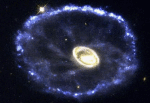 The Cartwheel Galaxy
2.07.1995
The Cartwheel Galaxy shows a ring that is the result of a collision between a small and a large galaxy. After a small galaxy has moved through a big galaxy - in this case...
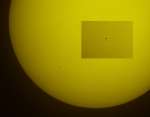 Atlantis and Hubble Side by Side
16.05.2009
On Wednesday, May 13, two, tiny, fast moving spots crossed an otherwise featureless solar disk. Not sunspots though, the dark blemishes were silhouettes of the shuttle orbiter Atlantis and the Hubble Space Telescope side by side.
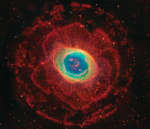 Rings Around the Ring Nebula
13.08.2014
It is a familiar sight to sky enthusiasts with even a small telescope. There is much more to the Ring Nebula (M57), however, than can be seen through a small telescope. The easily visible...
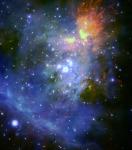 The Orion Nebula from Subaru
2.02.1999
The Orion Nebula (M42) shows a host of treasures when viewed in infrared light. Some stars in the Trapezium, an open cluster of stars at the center, are only visible in infrared light. The orange feature above center is called the Kleinman-Low Nebula, and appears greatly affected by newly forming central star IRc2.
|
January February March April May June July August September October |
|||||||||||||||||||||||||||||||||||||||||||||||||