
|
You entered: telescope
 APOD: 2023 August 22 Б The Pistachio Nebula
22.08.2023
This nebula had never been noted before. Newly discovered nebulas are usually angularly small and found by professionals using large telescopes. In contrast, the Pistachio Nebula was discovered by dedicated amateurs and, although faint, is nearly the size of the full Moon.
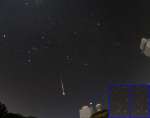 Leonid Fireball over Tenerife
22.11.2011
Historically active, this year's Leonid meteor shower was diminished by bright moonlight. Still, faithful night sky watchers did see the shower peak on November 18 and even the glare of moonlight didn't come close to masking this brilliant fireball meteor.
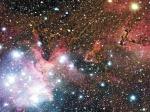 In the Center of the Heart Nebula
8.12.2004
What powers the Heart Nebula? The large emission nebula dubbed IC 1805 looks, in whole, like a human heart. The nebula glows brightly in red light emitted by its most prominent element: hydrogen. The red glow and the larger shape are all created by a small group of stars near the nebula's center.
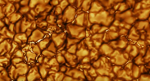 Solar Granules at Record High Resolution
3.02.2020
Why does the Sun's surface keep changing? The help find out, the US National Science Foundation (NSF) has built the Daniel K. Inouye Solar Telescope in Hawaii, USA. The Inouye telescope...
 Asteroid 2007 TU24 Passes the Earth
30.01.2008
Asteroid 2007 TU24 passed by the Earth yesterday, posing no danger. The space rock, estimated to be about 250 meters across, coasted by just outside the orbit of Earth's Moon. The passing...
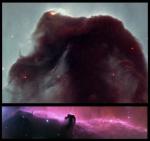 Horsehead Rides Again
26.04.2001
Difficult to see in small telescopes, the Horsehead nebula was recently selected by internet voters as a target for the Hubble Space Telescope. Above (top) is Hubble's detailed view of the dark cosmic dust cloud, released to celebrate the 11th anniversary of the workhorse orbiting observatory.
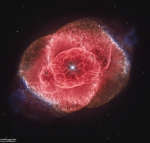 In the Center of the Cats Eye Nebula
10.07.2022
Three thousand light-years away, a dying star throws off shells of glowing gas. This image from the Hubble Space Telescope reveals the Cat's Eye Nebula (NGC 6543), to be one of the most complex planetary nebulae known.
 APOD: 2024 November 26 Б The Sombrero Galaxy from Webb and Hubble
26.11.2024
This floating ring is the size of a galaxy. In fact, it is a galaxy -- or at least part of one: the photogenic Sombrero Galaxy is one of the largest galaxies in the nearby Virgo Cluster of Galaxies.
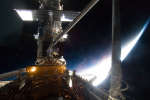 Above Earth Fixing Hubble
20.05.2009
What is that astronaut doing? Fixing the Hubble Space Telescope. During the fourth servicing mission to upgrade and fix Hubble, astronaut Michael Good can be seen attached to the shuttle's robotic arm, working in an open panel of Hubble. Far below, the terminator between day and night can be seen across planet Earth.
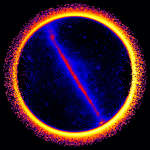 Gamma Ray Earth and Sky
6.12.2013
For an Earth-orbiting gamma-ray telescope, Earth is actually the brightest source of gamma-rays, the most energetic form of light. Gamma-rays from Earth are produced when high energy particles, cosmic rays from space, crash into the atmosphere.
|
January February March April May June July August September October |
|||||||||||||||||||||||||||||||||||||||||||||||||