
|
You entered: telescope
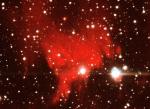 Nebula Nova Cygni Turns On
25.08.2002
Old photographs show no evidence of the above nebula. In 1992, a white dwarf star toward the constellation of Cygnus blew off its outer layers in a classical nova explosion: an event called Nova Cygni 1992.
 Edwin Hubble Discovers the Universe
21.06.1998
No person in history has had greater impact in determining the extent of our universe than Edwin Hubble. From proving that other galaxies existed to proving that galaxies move apart from one another, Hubble's work defined our place in the cosmos.
 A Year of New Perspectives
28.12.1999
Fittingly, 1999 saw a decade of astronomical discoveries to an end with portents of things to come - embodied in new spacecraft, telescopes, and perspectives to explore the distant Universe across the electromagnetic spectrum. X-ray astronomy in particular will likely flourish in coming
 Structure in N63A
1.01.2004
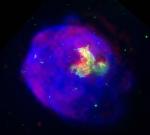
Shells and arcs abound in this false-color, multiwavelength view of supernova remnant N63A, the debris of a massive stellar explosion. The x-ray emission (blue), is from gas heated to 10 million degrees C as knots of fast moving material from the cosmic blast sweep up surrounding interstellar matter.
 M87s Central Black Hole in Polarized Light
31.03.2021
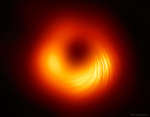
To play on Carl SaganБs famous words "If you wish to make black hole jets, you must first create magnetic fields." The featured image represents the detected intrinsic spin direction (polarization) of radio waves. The polarizationi is produced by the powerful magnetic field surrounding the supermassive black hole at the center of elliptical galaxy M87.
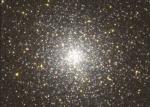 Globular Cluster 47 Tucanae
22.04.2001
Stars come in bunches. Of the over 200 globular star clusters that orbit the center of our Milky Way Galaxy, 47 Tucanae is the second brightest globular cluster (behind Omega Centauri). Known to some affectionately as 47 Tuc or NGC 104, it is only visible from the Southern Hemisphere.
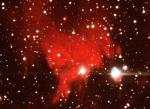 Nebula Nova Cygni Turns On
16.01.2005
Old photographs show no evidence of the above nebula. In 1992, a white dwarf star toward the constellation of Cygnus blew off its outer layers in a classical nova explosion: an event called Nova Cygni 1992.
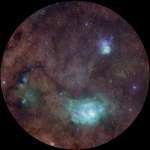 Pan STARRS and Nebulae
12.10.2012
A single image from the world's most powerful survey instrument captured this spectacular skyview. Looking toward Sagittarius, the scene spans nearly 3 degrees or six times the width of the Full Moon.
 Milky Way Rising
1.12.2023
The core of the Milky Way is rising beyond the Chilean mountain-top La Silla Observatory in this deep night skyscape. Seen toward the constellation Sagittarius, our home galaxy's center is flanked...
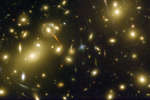 Abell 2218: A Galaxy Cluster Lens
10.02.2008
Gravity can bend light, allowing huge clusters of galaxies to act as telescopes. Almost all of the bright objects in this Hubble Space Telescope image are galaxies in the cluster known as Abell 2218.
|
January February March April May June July August September October |
|||||||||||||||||||||||||||||||||||||||||||||||||