
|
You entered: telescope
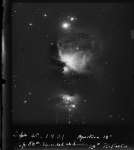 1901 Photograph: The Orion Nebula
17.08.2019
By the turn of the 20th century advances in photography contributed an important tool for astronomers. Improving photographic materials, long exposures, and new telescope designs produced astronomical images with details not visible at the telescopic eyepiece alone.
 A Cosmic Call to Nearby Stars
12.07.2009
If Earth received this message from deep space, could we decode it? The people from the Cosmic Call project sent the above image as the first page of a longer message. The message was broadcast toward local stars by radio telescope during the summer of 1999. Another message was sent in 2003.
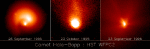 Comet Hale-Bopp Inbound
19.12.1996
Headed toward the inner Solar System, the much anticipated Comet Hale-Bopp has promised to put on a big show next spring. The comet's apparent brightness is currently approaching 4th magnitude and its inbound journey has been closely followed by many observers.
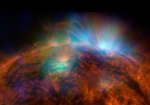 The Sun in X rays from NuSTAR
28.12.2014
Why are the regions above sunspots so hot? Sunspots themselves are a bit cooler than the surrounding solar surface because the magnetic fields that create them reduce convective heating. It is therefore unusual that regions overhead -- even much higher up in the Sun's corona -- can be hundreds of times hotter.
 APOD: 2023 July 18 Б Milky Way above La Palma Observatory
18.07.2023
What's happening in the night sky? To help find out, telescopes all over the globe will be pointing into deep space. Investigations will include trying to understand the early universe, finding and tracking Earth-menacing asteroids, searching for planets that might contain extra-terrestrial life, and monitoring stars to help better understand our Sun.
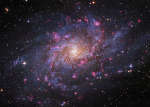 The Hydrogen Clouds of M33
3.10.2019
Gorgeous spiral galaxy M33 seems to have more than its fair share of glowing hydrogen gas. A prominent member of the local group of galaxies, M33 is also known as the Triangulum Galaxy and lies a mere 3 million light-years away.
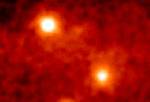 Gamma Ray Crab, Geminga
24.06.1995
What if you could "see" in gamma-rays? If you could, these two spinning neutron stars or pulsars would be among the brightest objects in the sky. This computer processed image shows the Crab Nebula pulsar (below and right of center) and the Geminga pulsar (above and left of center) in the "light" of gamma-rays.
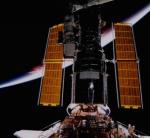 Hubble Holiday
24.12.1999
How would you like to spend your holiday in low earth orbit? That's what the crew of the space shuttle Discovery is doing as they deliver six new gyros and a faster main computer to the orbiting Hubble Space Telescope.
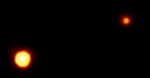 Pluto: The Frozen Planet
18.08.1995
The Hubble Space Telescope imaged Pluto and its moon Charon in 1994. Pluto is usually the most distant planet from the Sun but because of its elliptic orbit Pluto crossed inside of Neptune's orbit in 1979 and will cross back out again in 1999.
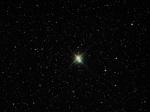 Albireo: A Bright and Beautiful Double
30.08.2005
Sometimes, even a small telescope can help unlock a hidden beauty of the heavens. Such is the case of the bright double star Albireo. Seen at even slight magnification, Albireo unfolds from a bright single point into a beautiful double star of strikingly different colors.
|
January February March April May June July August September October |
|||||||||||||||||||||||||||||||||||||||||||||||||