
|
You entered: telescope
 Molecular Clouds in the Carina Nebula
2.10.2019
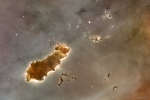
They are not alive -- but they are dying. The unusual forms found in the Carina nebula, a few of which are featured here, might best be described as evaporating. Energetic light and winds from nearby stars are breaking apart the dark dust grains that make the iconic forms opaque.
 APOD: 2023 July 10 Б Stars, Dust and Nebula in NGC 6559
10.07.2023
When stars form, pandemonium reigns. A textbook case is the star forming region NGC 6559. Visible in the featured image are red glowing emission nebulas of hydrogen, blue reflection nebulas of dust, dark absorption nebulas of dust, and the stars that formed from them.
 ELT and the Milky Way
16.03.2024
The southern winter Milky Way sprawls across this night skyscape. Looking due south, the webcam view was recorded near local midnight on March 11 in dry, dark skies over the central Chilean Atacama desert.
 3I/ATLAS Flyby
26.12.2025
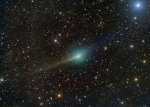
Attention grabbing interstellar visitor 3I/ATLAS made its not-so-close flyby of our fair planet on December 19 at a distance of 1.8 astronomical units. That's about 900 light-seconds. This deep exposure captures the comet...
 The Galaxy, the Jet, and a Famous Black Hole
15.04.2021
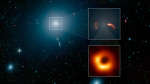
Bright elliptical galaxy Messier 87 (M87) is home to the supermassive black hole captured by planet Earth's Event Horizon Telescope in the first ever image of a black hole. Giant of the Virgo...
 The Cat's Eye Nebula
2.08.1997
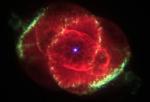
Three thousand light years away, a dying star throws off shells of glowing gas. This image from the Hubble Space Telescope reveals "The Cat's Eye Nebula" to be one of the most complex planetary nebulae known.
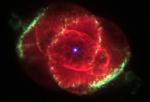 The Cat's Eye Nebula
1.11.1998
Three thousand light years away, a dying star throws off shells of glowing gas. This image from the Hubble Space Telescope reveals The Cat's Eye Nebula to be one of the most complex planetary nebulae known.
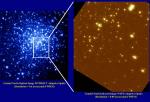 NGC 6934 from Gemini North
30.06.1999
What's going on near the center of globular cluster NGC 6934? The blur caused by the Earth's atmosphere has prevented astronomers from discerning individual stars in this unusual environment. Telescopes in space can help, but the new Gemini North telescope took the above picture from the ground.
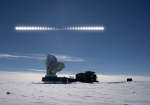 Postcard from the South Pole
11.12.2021
From this vantage point about three quarters of a mile from planet Earth's geographic South Pole, the December 4 eclipse of the Sun was seen as a partial eclipse. At maximum eclipse the New Moon blocked 90 percent of the solar disk.
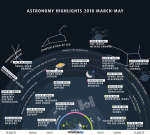 Night Sky Highlights: March to May
14.03.2018
What might you see in the night sky over the next few months? The featured graphic gives a few highlights. Viewed as a clock face centered at the bottom, sky events in March fan out toward the left, April toward the top, and May toward the right.
|
January February March April May June July August September October |
|||||||||||||||||||||||||||||||||||||||||||||||||