
|
You entered: dark
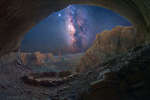 A True Image from False Kiva
29.09.2008
Is there any place in the world you could see a real sight like this? Yes. Pictured above is single exposure image spectacular near, far, and in between. Diving into the Earth far in the distance is part of the central band of our Milky Way Galaxy, taken with a long duration exposure.
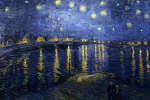 Starry Night Over the Rhone
21.09.2010
How can the majesty of the night sky best be captured in a painting? This was a continual challenge for Vincent van Gogh, a famous painter in the late 1800s who pioneered stirring depictions of star filled skies into several of his works.
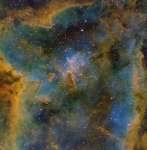 Melotte 15 in the Heart
25.09.2010
Cosmic clouds seem to form fantastic shapes in the central regions of emission nebula IC 1805. Of course, the clouds are sculpted by stellar winds and radiation from massive hot stars in the nebula's newborn star cluster, Melotte 15.
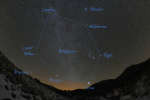 Winter Hexagon Over Stagecoach Colorado
3.01.2011
If you can find Orion, you might be able to find the Winter Hexagon. The Winter Hexagon involves some of the brightest stars visible, together forming a large and easily found pattern in the winter sky of Earth's northern hemisphere.
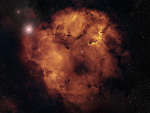 Monsters of IC 1396
25.04.2011
Is there a monster in IC 1396? Known to some as the Elephant's Trunk Nebula, parts of the glowing gas and dust clouds of this star formation region may appear to take on foreboding forms, some nearly human. The entire nebula might even look like a face of a monster.
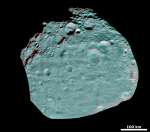 Stereo Vesta
20.08.2011
Get out your red/blue glasses and float next to 4 Vesta. A 500 kilometer diameter world, Vesta lies in the main asteroid belt between the orbits of Mars and Jupiter. This stereo anaglyph...
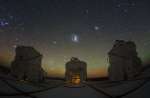 3 ATs
3 ATs
21.04.2012
Despite their resemblance to R2D2, these three are not the droids you're looking for. Instead, the enclosures house 1.8 meter Auxiliary Telescopes (ATs) at Paranal Observatory in the Atacama Desert region of Chile.
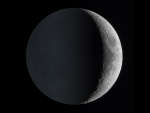 Sunshine, Earthshine
19.03.2015
Today's date marks an Equinox and a New Moon. Remarkably, while the exact timing of both geocentric events occur within a span of only 13 hours, the moon also reaches its new phase only 14 hours after perigee, the closest point in its orbit.
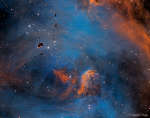 Stars and Globules in the Running Chicken Nebula
20.01.2016
The eggs from this gigantic chicken may form into stars. The featured emission nebula, shown in scientifically assigned colors, is cataloged as IC 2944 but known as the Running Chicken Nebula for the shape of its greater appearance. Seen toward the top of the image are small, dark molecular clouds rich in obscuring cosmic dust.
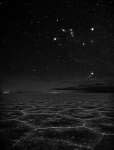 Luminous Salar de Uyuni
15.04.2017
A scene in high contrast this thoughtful night skyscape is a modern composition inspired by M. C. Escher's lithograph Phosphorescent Sea. In it, bright familiar stars of Orion the Hunter and Aldebaran, eye of Taurus the Bull, hang in clear dark skies above a distant horizon.
|
January February March April May June July August September |
|||||||||||||||||||||||||||||||||||||||||||||||||