
|
You entered: dark
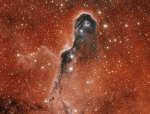 An Unusual Globule in IC 1396
14.04.2014
Is there a monster in IC 1396? Known to some as the Elephant's Trunk Nebula, parts of gas and dust clouds of this star formation region may appear to take on foreboding forms, some nearly human. The only real monster here, however, is a bright young star too far from Earth to hurt us.
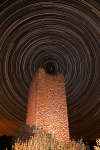 The North Celestial Tower
15.07.2016
If you climbed to the top of this 13th century stone tower, it looks like you could reach out and touch the North Celestial Pole, the point at the center of all the star trail arcs.
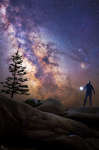 Behold the Universe
2.08.2016
What if you climbed up on a rock and discovered the Universe? You can. Although others have noted much of it before, you can locate for yourself stars, planets, and even the plane of our Milky Way Galaxy. All you need is a dark clear sky -- the rock is optional.
 Earth at Night
8.07.2017
Can you find your favorite country or city? Surprisingly, on this world-wide nightscape, city lights make this task quite possible. Human-made lights highlight particularly developed or populated areas of the Earth's surface, including the seaboards of Europe, the eastern United States, and Japan.
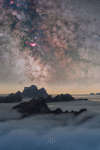 Clouds of Earth and Sky
23.07.2018
If you go high enough, you may find yourself on a picturesque perch between the water clouds of the Earth and the star clouds of the Milky Way. Such was the case last month for one adventurous alpinist astrophotographer.
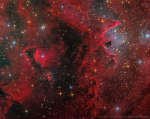 IC 1871: Inside the Soul Nebula
27.11.2018
This cosmic close-up looks deep inside the Soul Nebula. The dark and brooding dust clouds on the left, outlined by bright ridges of glowing gas, are cataloged as IC 1871. About 25 light-years across, the telescopic field of view spans only a small part of the much larger Heart and Soul nebulae.
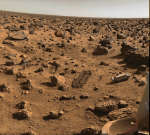 Utopia on Mars
20.05.2021
Expansive Utopia Planitia on Mars is strewn with rocks and boulders in this 1976 image. Constructed from the Viking 2 lander's color and black and white image data, the scene approximates the appearance of the high northern martian plain to the human eye.
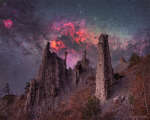 Milky Way over French Alp Hoodoos
15.05.2022
Real castles aren't this old. And the background galaxy is even older. Looking a bit like an alien castle, the pictured rock spires are called hoodoos and are likely millions of years old. Rare, but found around the world, hoodoos form when dense rocks slow the erosion of softer rock underneath.
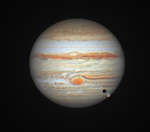 In Ganymede s Shadow
6.10.2022
At opposition, opposite the Sun in Earth's sky, late last month Jupiter is also approaching perihelion, the closest point to the Sun in its elliptical orbit, early next year. That makes Jupiter exceptionally close to our fair planet, currently resulting in excellent views of the Solar System's ruling gas giant.
 APOD: 2025 February 23 Б Saturn in Infrared from Cassini
22.02.2025
Saturn looks slightly different in infrared light. Bands of clouds show great structure, including long stretching storms. Also quite striking in infrared is the unusual hexagonal cloud pattern surrounding Saturn's North Pole. Each side of the dark hexagon spans roughly the width of our Earth.
|
January February March April May June July August September |
|||||||||||||||||||||||||||||||||||||||||||||||||