
|
You entered: dark
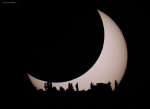 APOD: 2026 August 9 Б Contemplating the Sun
9.08.2026
Have you contemplated your home star recently? Featured here, a Sun partially eclipsed on the top left by the Moon is also seen eclipsed by earthlings contemplating the eclipse below. This spectacular menagerie...
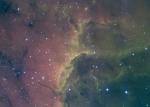 Pelican Nebula Ionization Front
3.07.2000
The Pelican Nebula is slowly being transformed. IC 5070, the official designation, is divided from the larger North America Nebula by a molecular cloud filled with dark dust. The Pelican, however, receives much study because it is a particularly active mix of star formation and evolving gas clouds.
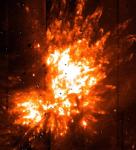 The Kleinmann Low Nebula
2.03.1999
The most active part of the Orion Nebular Cloud Complex is an area known as the Kleinmann-Low Nebula. There, a cluster of young and forming stars is embedded in a molecular cloud filled with dust.
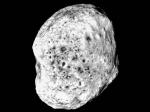 Hyperion: Sponge Moon of Saturn
26.07.2005
Why is Saturn's moon Hyperion textured like a sponge? Recent high-resolution images from the robot Cassini spacecraft orbiting Saturn show Hyperion to be an even stranger place than thought before. Previously, it was known that the length of a day on Hyperion is unpredictable.
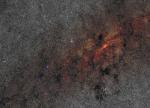 The Galactic Center in Infrared
16.07.2006
The center of our Galaxy is a busy place. In visible light, much of the Galactic Center is obscured by opaque dust. In infrared light, however, dust glows more and obscures less, allowing nearly one million stars to be recorded in the above photograph.
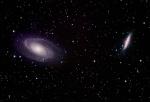 Galaxy Wars: M81 Versus M82
9.02.2000
In the left corner, wearing a red nucleus surrounded by blue spiral arms, is M81. In the right corner, sporting light stars and dark dust lanes, is M82. These two mammoth galaxies have been locked in gravitational combat for the past billion years.
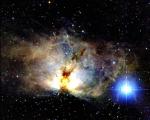 The Flame Nebula in Infrared
13.07.1999
What lights up the Flame Nebula? Fifteen hundred light years away towards the constellation of Orion lies a nebula which, from its glow and dark dust lanes, appears like a billowing fire. But fire, the rapid acquisition of oxygen, is not what makes this Flame glow.
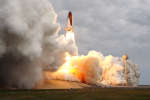 The Last Launch of Space Shuttle Endeavour
18.05.2011
Two days ago, powerful yet controlled explosions rocketed the Space Shuttle Endeavor on its final trip into Earth orbit. The above image was taken seconds after liftoff as the massive orbiter and six astronauts began a climb to a height where the atmosphere is so thin it is unbreathable.
 The Universe Nearby
14.06.2011
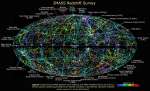
What does the universe nearby look like? This plot shows nearly 50,000 galaxies in the nearby universe detected by the Two Micron All Sky Survey (2MASS) in infrared light. The resulting image is anincredible tapestry of galaxies that provides limits on how the universe formed and evolved.
 The View from Chajnantor
23.11.2011
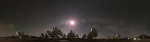
From an altitude of over 5,000 meters, the night sky view from Chajnantor Plateau in the Chilean Andes is breathtaking in more ways than one. The dark site's rarefied atmosphere, at about 50 percent sea level pressure, is also extremely dry.
|
January February March April May June July August September |
|||||||||||||||||||||||||||||||||||||||||||||||||