
|
You entered: space
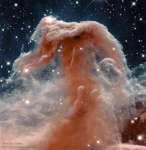 The Horsehead Nebula in Infrared from Hubble
21.09.2022
While drifting through the cosmos, a magnificent interstellar dust cloud became sculpted by stellar winds and radiation to assume a recognizable shape. Fittingly named the Horsehead Nebula, it is embedded in the vast and complex Orion Nebula (M42).
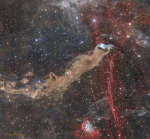 Wolfs Cave Nebula
15.11.2022
The mysterious blue reflection nebula found in catalogs as VdB 152 or Ced 201 really is very faint. It lies at the tip of the long dark nebula Barnard 175 in a dusty complex that has also been called Wolf's Cave.
800px.preview.jpg) 2023 CX1 Meteor Flash
2023 CX1 Meteor Flash
17.02.2023
While scanning the skies for near earth objects Hungarian astronomer Krisztiцn Sцrneczky first imaged the meter-sized space rock now cataloged as 2023 CX1 on 12 February 2023 at 20:18:07 UTC. That was about 7 hours before it impacted planet Earth's atmosphere.
 LEDA 1313424: The Bullseye Galaxy
7.02.2025
The giant galaxy cataloged as LEDA 1313424 is about two and a half times the size of our own Milky Way. Its remarkable appearance in this recently released Hubble Space Telescope image strongly suggests its nickname "The Bullseye Galaxy".
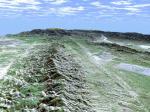 Earths San Andreas Fault
7.12.2000
The Earth's surface is broken. Cracks in the Earth's crust known as faults can run for hundreds of kilometers. These faults are frequently the sites of major earthquakes as the tectonic plates that cover the surface of the Earth shift.
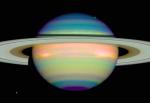 Infrared Saturn
22.02.2003
This delightfully detailed false-color image of Saturn was taken in January 1998 by the orbiting Hubble Space Telescope. The picture is a combination of three images from Hubble's NICMOS instrument and shows the lovely ringed planet in reflected infrared sunlight.
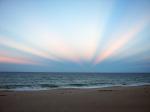 Anticrepuscular Rays Over Florida
17.09.2006
What's happening over the horizon? Although the scene may appear somehow supernatural, nothing more unusual is occurring than a setting Sun and some well placed clouds. Strangely, the actual sunset was occurring in the opposite direction from where the camera was pointing. Pictured above are anticrepuscular rays.
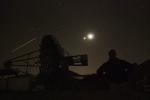 VERITAS and Venus
8.11.2007
Early morning risers and late to bed astronomers have recently enjoyed bright planets in predawn skies, with brilliant Venus above the eastern horizon. On November 5, Venus was joined by the waning crescent Moon.
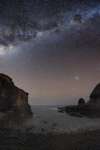 The Milky Way Over Pulpit Rock
5.07.2010
Can a picture of the sky be relaxing? A candidate for such a picture might be the above image taken only last month from Cape Schank, Victoria, Australia. The frame is highlighted by a quiet lagoon, soft ground fog, two galaxies, and tens of thousands of stars.
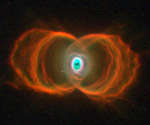 MyCn18: An Hourglass Planetary Nebula
7.08.2011
The sands of time are running out for the central star of this hourglass-shaped planetary nebula. With its nuclear fuel exhausted, this brief, spectacular, closing phase of a Sun-like star's life occurs as its outer layers are ejected - its core becoming a cooling, fading white dwarf.
|
January February March April May June July August September October |
|||||||||||||||||||||||||||||||||||||||||||||||||