
|
You entered: space
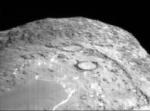 The Landscape on Comet Tempel 1
6.07.2005
This diverse landscape is the surface of comet Temple 1's nucleus as seen by the Deep Impact probe's Impactor Targeting Sensor. Within minutes of recording the rugged view, the landscape had changed dramatically though, as the impactor smashed into the surface near the two large, half kilometer-sized craters at picture center.
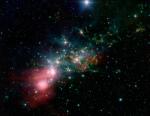 Dusty NGC 1333
23.11.2005
Dusty NGC 1333 is seen as a reflection nebula in visible light images, sporting bluish hues characteristic of starlight reflected by dust. But at longer infrared wavelengths, the interstellar dust itself glows - shown in red in this false-color Spitzer Space Telescope image.
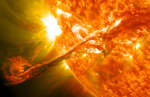 A Solar Filament Erupts
17.09.2012
What's happened to our Sun? Nothing very unusual -- it just threw a filament. At the end of last month, a long standing solar filament suddenly erupted into space producing an energetic Coronal Mass Ejection (CME).
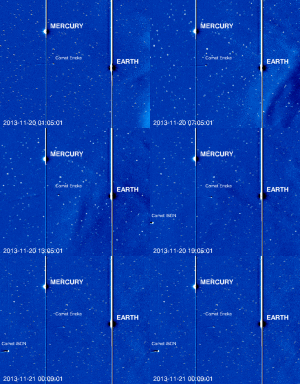 Comet ISON from STEREO
23.11.2013
Still intact, on November 21 Comet ISON (C/2012 S1) swept into this animated field of view (left) from the HI-1 camera on the STEREO-A spacecraft. The camera has also captured periodic Comet Encke, Mercury, and Earth, with the Sun cropped out of the frame at the right, the source of the billowing solar wind.
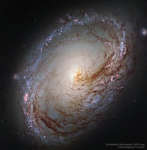 Spiral Galaxy M96 from Hubble
20.09.2015
Dust lanes seem to swirl around the core of Messier 96 in this colorful, detailed portrait of the center of a beautiful island universe. Of course M96 is a spiral galaxy, and counting...
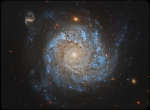 NGC 1309: Spiral Galaxy and Friends
13.07.2016
A gorgeous spiral galaxy some 100 million light-years distant, NGC 1309 lies on the banks of the constellation of the River (Eridanus). NGC 1309 spans about 30,000 light-years, making it about one third the size of our larger Milky Way galaxy.
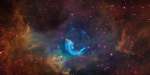 Approaching the Bubble Nebula
30.05.2017
What would it look like to approach the Bubble Nebula? Blown by the wind and radiation from a massive star, this bubble now spans seven light-years in diameter. The hot star inside is thousands of times more luminous than our Sun, and is now offset from the nebula's center.
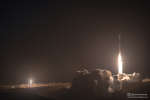 West Coast Launch and Landing
10.10.2018
A SpaceX Falcon 9 rocket launch dazzled viewers along the U.S. west coast after sunset on October 7. Rising from Vandenberg Air Force Base, California, planet Earth, the Falcon 9's first stage then returned to a landing zone some 400 meters from the launch site less than 8 minutes after liftoff.
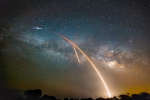 Milky Way, Launch, and Landing
10.05.2019
The Milky Way doesn't look quite this colorful and bright to the eye, but a rocket launch does. So a separate deep exposure with a sensitive digital camera was used in this composite skyscape to bring out our galaxy's central crowded starfields and cosmic dust clouds.
 APOD: 2024 February 26 Б Martian Moon Eclipses Martian Moon
25.02.2024
What if there were two moons in the sky -- and they eclipsed each other? This happens on Mars. The featured video shows a version of this unusual eclipse from space. Pictured are the two moons of Mars: the larger Phobos, which orbits closer to the red planet, and the smaller Deimos, which orbits further out.
|
January February March April May June July August September October |
|||||||||||||||||||||||||||||||||||||||||||||||||