
|
You entered: ring
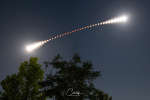 A Digital Lunar Eclipse
19.05.2022
Recorded on May 15/16 this sequence of exposures follows the Full Moon during a total lunar eclipse as it arcs above treetops in the clearing skies of central Florida. A frame taken every 5 minutes by a digital camera shows the progression of the eclipse over three hours.
 A Cosmic Rose: NGC 2237 in Monoceros
14.02.2025
The Rosette Nebula, NGC 2237, is not the only cosmic cloud of gas and dust to evoke the imagery of flowers, but it is probably the most famous. At the edge of a large molecular cloud in Monoceros some 5,000 light years away, the petals of this cosmic rose are actually a stellar nursery.
 A Chicago Meteorite Fall
6.05.2003
If you wait long enough, a piece of outer space itself will come right to you. As Colby Navarro worked innocently on the computer, a rock from space crashed through the roof, struck the printer, banged off the wall, and came to rest near the filing cabinet.
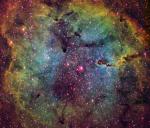 Emission Nebula IC 1396
5.08.2004
Sprawling across hundreds of light-years, emission nebula IC 1396 mixes glowing cosmic gas and dark dust clouds. Stars are forming in this area, only about 3,000 light-years from Earth. This particularly colorful view of the region is a composite of digital images recorded through narrow band filters.
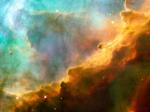 APOD: 2004 August 28- M17: A Hubble Close-Up
28.08.2004
Sculpted by stellar winds and radiation, these fantastic, undulating shapes lie within the stellar nursery known as M17, the Omega Nebula, some 5,500 light-years away in the nebula-rich constellation Sagittarius. The lumpy features...
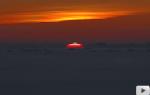 Movie: A Green Flash Over Italy
29.01.2007
How could the Sun turn green? Difficult to observe, the momentary green flash above the rising or setting sun has been documented as a phenomenon caused by the atmospheric bending or refraction of sunlight.
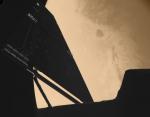 Rosetta Over Mars
1.03.2007
Panels on ESA's Rosetta spacecraft appear in the foreground of this intriguing image of Mars recorded on February 25 at a range of about 1,000 kilometers. Launched in March 2004, Rosetta...
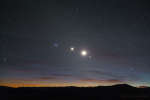 A Morning Line of Stars and Planets
11.07.2012
Early morning dog walkers got a visual treat last week as bright stars and planets appeared to line up. Pictured above, easily visible from left to right, were the Pleiades open star cluster, Jupiter, Venus, and the "Follower" star Aldebaran, all seen before a starry background.
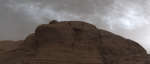 The Shining Clouds of Mars
5.06.2021
The weathered and layered face of Mount Mercou looms in the foreground of this mosaic from the Curiosity Mars rover's Mast Camera. Made up of 21 individual images the scene was recorded just after sunset on March 19, the 3,063rd martian day of Curiosity's on going exploration of the Red Planet.
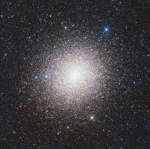 Globular Star Cluster 47 Tuc
10.03.2022
Globular star cluster 47 Tucanae is a jewel of the southern sky. Also known as NGC 104, it roams the halo of our Milky Way Galaxy along with some 200 other globular star clusters. The second brightest globular cluster (after Omega Centauri) as seen from planet Earth, 47 Tuc lies about 13,000 light-years away.
|
January February March April May June July August September October |
|||||||||||||||||||||||||||||||||||||||||||||||||