
|
You entered: Moon
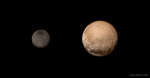 New Horizons Passes Pluto and Charon
14.07.2015
Will the New Horizons spacecraft survive its closest approach to Pluto and return useful images and data? Humanity will know in a few hours. Regardless of how well it functions, New Horizon's rapid...
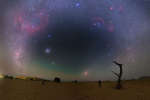 A Gegenschein Lunar Eclipse
14.10.2015
Is there anything interesting to see in the direction opposite the Sun? One night last month, there were quite a few things. First, the red-glowing orb on the lower right of the featured image is the full moon, darkened and reddened because it has entered Earth's shadow.
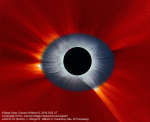 Combined Solar Eclipse Corona from Earth and Space
12.04.2016
Sometimes, a total eclipse is a good time to eye the Sun. Taking advantage of an unusual juxtaposition of Earth, Moon and Sun, the featured image depicts the total solar eclipse that occurred last month as it appeared -- nearly simultaneously -- from both Earth and space.
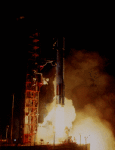 Surveyor Night Launch
3.11.1996
In early November of 1967, a dramatic night launch of an Atlas Centaur rocket from Cape Canaveral lofted the successful Surveyor 6 spacecraft toward the Moon. The Surveyor series of robotic probes carried out the first US lunar soft landings in preparation for the Apollo program.
 Comet Hyakutake's Closest Approach
24.03.1996
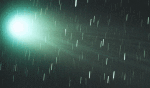
The above true color image of Comet Hyakutake was taken the night of March 21/22. Tonight, Comet Hyakutake will make its nearest approach to Earth, closing to a mere 10 million miles as it passes over the planet's Northern Hemisphere.
 Worlds of a Distant Sun: 47 Ursae Majoris b
1.07.1996
Within the last few years, observational astronomy has given humanity evidence of the existence of worlds beyond the solar system. Indeed, solar-type stars are now inferred to harbor planets of approximately Jupiter mass - some residing in temperature zones which could conceivably support liquid water and therefore life!
 Sizzling Io
6.07.1998
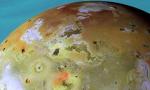
What's cooking on Io? This active moon of Jupiter is marked with volcanoes spewing lava that is now known to be hotter than any lava on Earth. Above is the highest resolution color-enhanced image yet composed of the most active surface in our Solar System. Features as small as three kilometers are visible.
 Callisto in True Color
11.05.1998
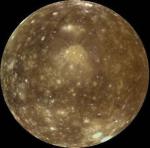
Callisto's surface has many stories to tell. The most distant of Jupiter's Galilean Moons, Callisto shows the highest density of impact craters in the Solar System, but harbors no volcanoes or even any large mountains. Callisto's surface is laced with cracks and craters from
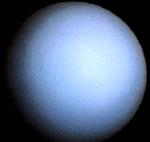 Uranus: The Tilted Planet
15.11.1997
Uranus is the third largest planet after Jupiter and Saturn. This picture was snapped by the Voyager 2 spacecraft in 1986 - the only spacecraft ever to visit Uranus. Uranus has many moons and a ring system. Uranus is composed mostly of rock and ices, but with a thick hydrogen and helium atmosphere.
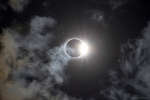 Diamond Ring in a Cloudy Sky
25.08.2017
As the Moon's shadow swept across the US on August 21, eclipse chasers in the narrow path of totality were treated to a diamond ring in the sky. At the beginning and end of totality, the fleeting and beautiful effect often produces audible gasps from an amazed audience.
|
January February March April May June July August September October |
|||||||||||||||||||||||||||||||||||||||||||||||||