
|
You entered: sky
 Mars 2020 from 5,000 Feet
31.07.2020
On Thursday this snapshot from a small plane 5,000 feet above Florida's Space Coast caught a rocket's trail rising into the blue morning sky. It was July's third launch of a mission from planet Earth bound for Mars.
 A Thousand Meteors
12.09.2020
Over a thousand meteors flash through the night in this intriguing timelapse video. Starting in April 2019 the individual video frames were selected from 372 relatively clear nights of imaging from an automated wide-field observatory in rural New South Wales Australia.
 APOD: 2023 November 29 Б A Landspout Tornado over Kansas
29.11.2023
Could there be a tornado inside another tornado? In general, no. OK, but could there be a tornado inside a wider dust devil? No again, for one reason because tornados comes down from the sky, but dust devils rise up from the ground.
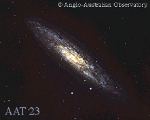 Spiral Galaxy NGC 253 Almost Sideways
2.11.1996
NGC 253 is a normal spiral galaxy seen here almost sideways. It is the largest member of the Sculptor Group of Galaxies, the nearest group to our own Local Group of Galaxies.
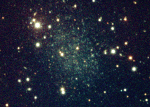 Antlia: A New Galactic Neighbor
23.04.1997
Meet Antlia, a newly discovered neighbor of our Milky Way Galaxy. Announced just last week, this faint member of our Local Group of Galaxies has only about one million stars. It is late in being noticed because it is so hard to see against a bright sky.
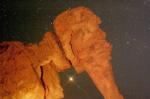 Mars Rising Behind Elephant Rock
28.08.2003
Yesterday, at about 10 am Universal Time, Mars and Earth passed closer than in nearly 60,000 years. Mars, noticeably red, remains the brightest object in the eastern sky just after sunset. The best...
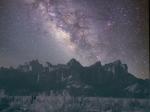 Heaven on Earth
23.02.2004
If sometimes it appears that the entire Milky Way Galaxy is raining down on your head, do not despair. It happens twice a day. As the Sun rises in the East, wonders of the night sky become less bright than the sunlight scattered by our own Earth's atmosphere, and so fade from view.
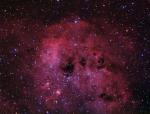 IC 410 and NGC 1893
15.08.2006
A faint, dusty rose of the northern sky, emission nebula IC 410 lies about 12,000 light-years away in the constellation Auriga. The cloud of glowing hydrogen gas is over 100 light-years across, sculpted by stellar winds and radiation from embedded open star cluster NGC 1893.
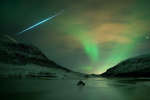 Aurora Shimmer, Meteor Flash
19.12.2009
Northern Lights, or aurora borealis, haunted skies over the island of Kvaløya, near Tromsø Norway on December 13. This 30 second long exposure records their shimmering glow gently lighting the wintery coastal scene.
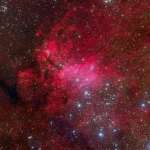 IC 4628: The Prawn Nebula
7.09.2012
South of Antares, in the tail of the nebula-rich constellation Scorpius, lies emission nebula IC 4628. Nearby hot, massive stars, millions of years young, radiate the nebula with invisible ultraviolet light, stripping electrons from atoms. The electrons eventually recombine with the atoms to produce the visible nebular glow, dominated by the red emission of hydrogen.
|
January February March April May June July August September October |
|||||||||||||||||||||||||||||||||||||||||||||||||