
|
You entered: gas
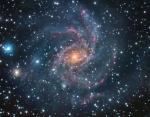 Facing NGC 6946
10.04.2004
From our vantage point in the Milky Way Galaxy, we see NGC 6946 face-on. The big beautiful spiral galaxy is located just 10 million light-years away, behind a veil of foreground stars in the high and far-off constellation of Cepheus.
 The Encke Gap: A Moon Goes Here
2.07.2004
Yesterday, Cassini became the first spacecraft to enter orbit around the gas giant Saturn, rocketing through a 25,000 kilometer wide gap in the distant planet's magnificent system of icy rings at about 15 kilometers per second.
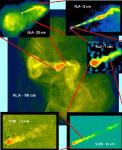 The Large and Small of M87
16.02.1999
The small core of elliptical galaxy M87 appears to be energizing its whole galactic neighborhood. Recent images from the Very Large Array (VLA) of radio telescopes indicate that huge bubbles of hot gas not only exist but are still being created. These bubbles measure 200,000 light-years across and surround the entire galaxy.
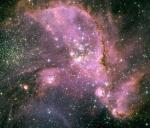 Young Stars of NGC 346
17.11.2005
Star cluster NGC 346 is embedded in the largest star forming region in the Small Magellanic Cloud, some 210,000 light-years distant. The massive stars of NGC 346 are short lived, but very energetic.
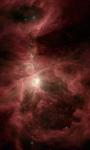 Spitzer s Orion
18.08.2006
Few cosmic vistas excite the imagination like the Orion Nebula, an immense stellar nursery some 1,500 light-years away. Also known as M42, the nebula is visible to the unaided eye, but this stunning...
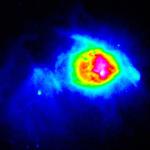 Hydrogen Blob N88A in the Small Magellanic Cloud
29.07.1999
The bright blob of hydrogen gas cataloged as N88A is seen at the right. It measures a mere 3 light years across. Emerging from the cool, dusty interstellar medium in a nearby irregular galaxy known as the Small Magellanic Cloud, N88A hides hot young stars at its core.
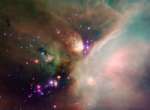 Young Stars in the Rho Ophiuchi Cloud
15.02.2008
Cosmic dust clouds and embedded newborn stars glow at infrared wavelengths in this tantalizing false-color view from the Spitzer Space Telescope. Pictured is of one of the closest star forming regions, part of the Rho Ophiuchi cloud complex some 400 light-years distant near the southern edge of the pronounceable constellation Ophiuchus.
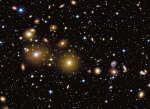 The Perseus Cluster of Galaxies
20.05.2008
Here is one of the largest objects that anyone will ever see on the sky. Each of these fuzzy blobs is a galaxy, together making up the Perseus Cluster, one of the closest clusters of galaxies. The cluster is seen through a foreground of faint stars in our own Milky Way Galaxy.
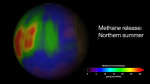 Methane Discovered in the Atmosphere of Mars
19.01.2009
Why is there methane on Mars? No one is sure. An important confirmation that methane exists in the atmosphere of Mars occurred last week, bolstering previous controversial claims made as early as 2003.
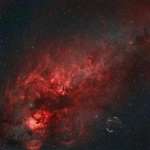 Nebulae in the Northern Cross
19.11.2010
Explore a beautiful and complex region of nebulae strewn along the plane of our Milky Way Galaxy in this widefield skyscape. The image emphasizes cosmic gas clouds in a 25 by 25 degree view centered on the Northern Cross, the famous asterism in the constellation Cygnus.
|
January February March April May June July August September October |
|||||||||||||||||||||||||||||||||||||||||||||||||