
|
You entered: gas
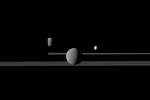 Ringside with Rhea
29.03.2013
Orbiting in the plane of Saturn's rings, Saturnian moons have a perpetual ringside view of the gas giant planet. Of course, while passing near the ring plane the Cassini spacecraft also shares their stunning perspective. The thin rings themselves slice across the middle of this Cassini snapshot from April 2011.
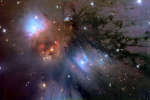 NGC 2170: Still Life with Reflecting Dust
7.07.2013
In this beautiful celestial still life composed with a cosmic brush, dusty nebula NGC 2170 shines at the upper left. Reflecting the light of nearby hot stars, NGC 2170 is joined by other bluish reflection nebulae, a compact red emission region, and streamers of obscuring dust against a backdrop of stars.
GB-finalLeshin1024.preview.jpg) The Elephant s Trunk Nebula in Cepheus
The Elephant s Trunk Nebula in Cepheus
19.01.2017
Like an illustration in a galactic Just So Story, the Elephant's Trunk Nebula winds through the emission nebula and young star cluster complex IC 1396, in the high and far off constellation of Cepheus. Also known as vdB 142, the cosmic elephant's trunk is over 20 light-years long.
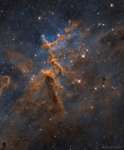 Melotte 15 inthe Heart
10.02.2017
Cosmic clouds form fantastic shapes in the central regions of emission nebula IC 1805. The clouds are sculpted by stellar winds and radiation from massive hot stars in the nebula's newborn star cluster, Melotte 15.
 APOD: 2024 November 12 Б NGC 6888: The Crescent Nebula
12.11.2024
How was the Crescent Nebula created? Looking like an emerging space cocoon, the Crescent Nebula, visible in the center of the featured image, was created by the brightest star in its center. A leading progenitor hypothesis has the Crescent Nebula beginning to form about 250,000 years ago.
 Orion and the Running Man
13.11.2025
Few cosmic vistas can excite the imagination like The Great Nebula in Orion. Visible as a faint, bland celestial smudge to the naked-eye, the nearest large star-forming region sprawls across this sharp colorful telescopic image. Designated M42 in the Messier Catalog, the Orion Nebula's glowing gas and dust surrounds hot, young stars.
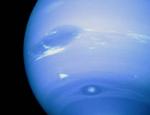 Dark Spots on Neptune
21.08.2001
Neptune has spots. The Solar System's outermost gas giant shows a nearly uniform blue hue created by small amounts of methane drifting in a thick atmosphere of nearly colorless hydrogen and helium. Dark spots do appear, however, that are anti-cyclones: large high-pressure systems that swirl in Neptune's cold cloud tops.
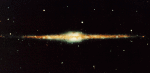 The Milky Way's Center
8.09.1995
NASA's COBE satellite scanned the heavens at infrared wavelengths in 1990 and produced this premier view of the central region of our own Milky Way Galaxy. The Milky Way is a typical spiral galaxy with a central bulge and extended disk of stars.
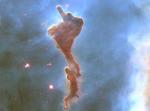 Disappearing Clouds in Carina
30.06.2003
This dense cloud of gas and dust is being deleted. Likely, within a few million years, the intense light from bright stars will have boiled it away completely. Stars not yet formed in the molecular cloud's interior will then stop growing.
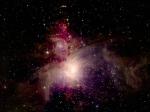 Orion Nebula: The 2MASS View
12.06.1998
Few astronomical sights excite the imagination like the nearby stellar nursery known as the Orion Nebula. The Nebula's glowing gas surrounds hot young stars at the edge of an immense interstellar molecular cloud only 1,500 light-years away.
|
January February March April May June July August September October |
|||||||||||||||||||||||||||||||||||||||||||||||||