
|
You entered: gas
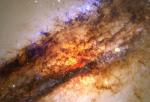 The Center of Centaurus A
22.05.1998
A fantastic jumble of young blue star clusters, gigantic glowing gas clouds, and imposing dark dust lanes surrounds the central region of the active galaxy Centaurus A. This mosaic of Hubble Space Telescope images taken in blue, green, and red light has been processed to present a natural color picture of this cosmic maelstrom.
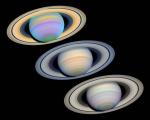 Saturn by Three
18.09.2003
These three views of Saturn were recorded by the Hubble Space Telescope on March 7th of this year, as the southern hemisphere of the solar system's most gorgeous planet reached its maximum 27 degree tilt toward Earth.
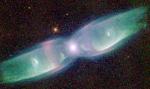 M2 9: Wings of a Butterfly Nebula
1.02.2004
Are stars better appreciated for their art after they die? Actually, stars usually create their most artistic displays as they die. In the case of low-mass stars like our Sun and M2-9 pictured above, the stars transform themselves from normal stars to white dwarfs by casting off their outer gaseous envelopes.
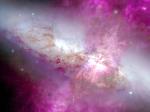 The Supergalactic Wind from Starburst Galaxy M82
1.06.2004
Star formation occurs at a faster pace in M82 -- a galaxy with about ten times the rate of massive star birth (and death) compared to our Milky Way. Winds from massive stars and blasts from supernova explosions have created a billowing cloud of expanding gas from this remarkable starburst galaxy.
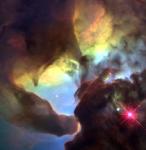 Twistin by the Lagoon
22.08.1998
The awesome spectacle of starbirth produces extreme stellar winds and intense energetic starlight -- bombarding dusty molecular clouds inside the Lagoon Nebula (M8). At least two long funnel shaped clouds, each roughly half a light-year long, have apparently been formed by this activity.
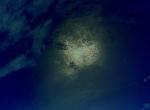 Spiral Eddies On Planet Earth
16.01.1999
Can you identify this wispy stellar nebula? How many light-years from Earth did you say? Resembling a twisting cloud of gas and dust between the stars this swirling form is actually close by - a spiral eddy formed near the North Atlantic Gulf Stream off the East coast of the U. S.
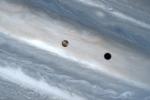 Io Shadow
23.04.1999
Orbiting Jupiter once every 43 hours, the volcanic moon Io cruises 500,000 kilometers above swirling, banded cloud-tops. Orbiting Earth once every 1.5 hours, the Hubble Space Telescope watched as Io accompanied by its shadow crossed the face of the reigning gas giant planet in 1997.
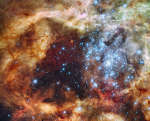 Star Cluster R136 Bursts Out
21.12.2009
In the center of star-forming region 30 Doradus lies a huge cluster of the largest, hottest, most massive stars known. These stars, known collectively as star cluster R136, were captured above in visible light by the newly installed Wide Field Camera peering though the recently refurbished Hubble Space Telescope.
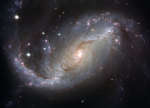 Spiral Galaxy NGC 1672 from Hubble
13.05.2012
Many spiral galaxies have bars across their centers. Even our own Milky Way Galaxy is thought to have a modest central bar. Prominently barred spiral galaxy NGC 1672, pictured above, was captured in spectacular detail in image taken by the orbiting Hubble Space Telescope.
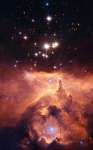 NGC 6357s Cathedral to Massive Stars
18.11.2012
How massive can a normal star be? Estimates made from distance, brightness and standard solar models had given one star in the open cluster Pismis 24 over 200 times the mass of our Sun, nearly making it the record holder.
|
January February March April May June July August September October |
|||||||||||||||||||||||||||||||||||||||||||||||||