
|
You entered: gas
 APOD: 2025 July 19 Б Messier 6
19.07.2025
The sixth object in Charles Messier's famous catalog of things which are not comets, Messier 6 is a galactic or open star cluster. A gathering of 100 stars or so, all around 100 million years young, M6 lies some 1,600 light-years away toward the central Milky Way in the constellation Scorpius.
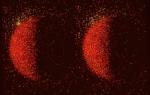 X Ray Moon and X Ray Star
9.09.2000
An x-ray star winks out behind the Moon in these before (left) and after views of a lunar occultation of the galactic x-ray source designated GX5-1. The false color images were made using data from the ROSAT (ROentgen SATellite), orbiting observatory.
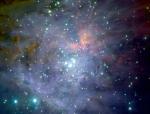 The Orion Nebula from VLT
30.01.2001
The Great Nebula in Orion is a colorful place. Visible to the unaided eye, it appears as a small fuzzy patch in the constellation of Orion. But this image, a representative-color composite...
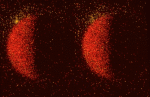 X-ray Moon and X-ray Star
27.02.1996
An X-ray star winks out behind the Moon in these before and after views of a lunar occultation of the galactic X-ray source designated GX5-1. The false color images were made using data...
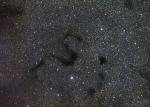 Snake in the Dark
20.06.2003
Dark nebulae snake across a gorgeous expanse of stars in this wide-field view toward the pronounceable constellation Ophiucus and the center of our Milky Way Galaxy. In fact, the central S-shape seen here is well known as the Snake Nebula.
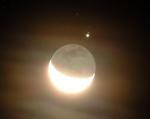 Jupiter and the Moon s Shadowed Horizon
9.12.2004
Early Tuesday morning, December 7th, June Croft thought the southeastern sky above Atmore, Alabama, USA was beautiful. Watching the Moon rise through gossamer clouds, she noted, " ... the crescent Moon looked like it was held in the sky by a star just off its shadowed horizon." What was that star?
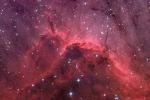 IC 5067: Emission Nebula Close up
27.12.2006
This amazing skyscape lies along a bright ridge of emission in IC 5067, also known as The Pelican Nebula. Appropriately, the Pelican Nebula itself is part of a much larger, complex star-forming region about 2,000 light-years away in the high flying constellation Cygnus, the Swan.
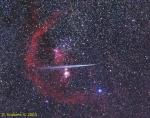 Rocket Fuel
16.11.2007
This gorgeous image of Orion shows off the constellation's young stars and cosmic clouds of hydrogen gas and dust. Made with a film camera tracking the stars on November 11, the exposure lasted some 40 minutes.
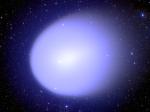 Expansive Comet Holmes
21.11.2007
The spherical coma of Comet Holmes has swollen to a diameter of over 1.4 million kilometers, making the tenuous, dusty cloud even bigger than the Sun. Scattering sunlight, all that dust and gas came...
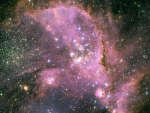 Young Stars of NGC 346
28.09.2008
The massive stars of NGC 346 are short lived, but very energetic. The star cluster is embedded in the largest star forming region in the Small Magellanic Cloud, some 210,000 light-years distant. Their...
|
January February March April May June July August September October |
|||||||||||||||||||||||||||||||||||||||||||||||||