
|
You entered: gas
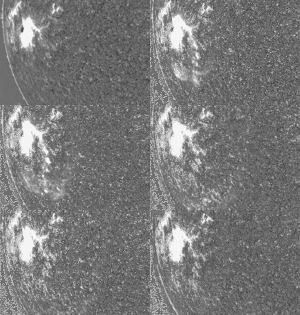 A Large Tsunami Shock Wave on the Sun
22.05.2022
Tsunamis this large don't happen on Earth. During 2006, a large solar flare from an Earth-sized sunspot produced a tsunami-type shock wave that was spectacular even for the Sun. Pictured here, the tsunami...
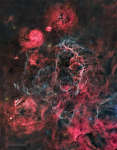 APOD: 2026 June 2 Б The Vela Supernova Remnant
2.06.2026
The explosion is over, but the consequences continue. About twelve thousand years ago, a relatively normal star in the constellation Vela suddenly exploded, creating a strange point of light briefly visible to humans living near the beginning of recorded history.
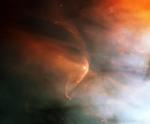 LL Orionis: When Cosmic Winds Collide
13.03.2002
This arcing, graceful structure is actually a bow shock about half a light-year across, created as the wind from young star LL Orionis collides with the Orion Nebula flow. Adrift in Orion's stellar...
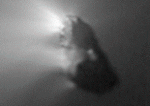 Comet Halley's Nucleus
10.12.1996
Here is what a comet nucleus really looks like. For all active comets except Halley, it was only possible to see the surrounding opaque gas cloud called the coma. During Comet Halley's most...
 Irregular Moons Discovered Around Uranus
3.11.1997
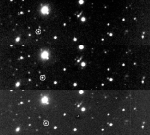
Where did these two irregular moons of Uranus originate? Last week two previously undiscovered moons of the distant gas planet were confirmed, the first in irregular orbits. All fifteen previously known moons of Uranus are 'regular', circling near the planet's equator. Most of these were discovered by the passing Voyager 2 spacecraft in 1986.
 30 Doradus: The Tarantula Zone
12.12.2005
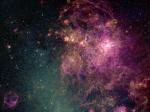
The Tarantula Nebula is more than 1,000 light-years across - a giant emission nebula within our neighboring galaxy the Large Magellanic Cloud. Inside this cosmic arachnid lies a central young cluster of massivestars, cataloged as R136, whose intense radiation and strong winds have helped energize the nebular glow and shape the spidery filaments.
 NGC 2261: Hubbles Variable Nebula
20.10.1999
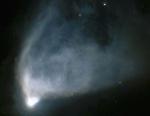
What causes Hubble's Variable Nebula to vary? The unusual nebula pictured above changes its appearance noticeably in just a few weeks. Discovered over 200 years ago and subsequently cataloged as NGC 2661, the remarkable nebula is named for Edwin Hubble, who studied it earlier this century.
 Rigel and the Witch Head Nebula
29.12.2009
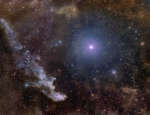
Double, double toil and trouble; Fire burn, and cauldron bubble -- maybe Macbeth should have consulted the Witch Head Nebula. This suggestively shaped reflection nebula on the lower left is associated with the bright star Rigel, to its right, in the constellation Orion.
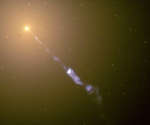 A Jet from Galaxy M87
28.08.2011
What's causing a huge jet to emanate from the center of galaxy M87? Although the unusual jet was first noticed early in the twentieth century, the exact cause is still debated. The above picture taken by the Hubble Space Telescope in 1998 shows clear details, however.
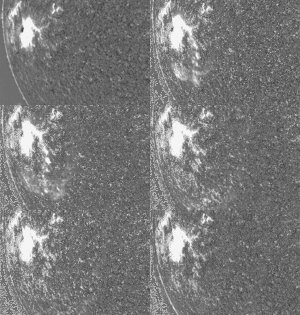 A Large Tsunami Shock Wave on the Sun
25.09.2011
Tsunamis this large don't happen on Earth. During 2006, a large solar flare from an Earth-sized sunspot produced a tsunami-type shock wave that was spectacular even for the Sun. Pictured above, the tsunami...
|
January February March April May June July August September October |
|||||||||||||||||||||||||||||||||||||||||||||||||