
|
You entered: gas
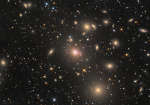 NGC 1275 in the Perseus Cluster
5.02.2026
Active galaxy NGC 1275 is the central, dominant member of the large and relatively nearby Perseus Cluster of Galaxies. Wild-looking at visible wavelengths, the active galaxy is also a prodigious source of x-rays and radio emission.
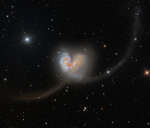 APOD: 2026 April 10 Б Exploring the Antennae
10.04.2026
Some 60 million light-years away in the southerly constellation Corvus, two large galaxies are colliding. Stars in the two galaxies, cataloged as NGC 4038 and NGC 4039, very rarely collide in the course of the ponderous cataclysm that lasts for hundreds of millions of years.
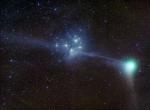 Machholz Meets the Pleiades
11.01.2005
Sweeping northward in planet Earth's sky, comet Machholz extended its long ion tail with the Pleiades star cluster in the background on January 7th. This stunning view, recorded with a telephoto lens in skies over Oberjoch, Bavaria, Germany, emphasizes faint, complex tail structures and the scene's lovely blue and green colors.
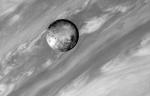 5 Million Miles From Io
11.03.1999
Twenty years ago this month, NASA's Voyager 1 spacecraft flew past Jupiter and its moons. This sharp picture of moon Io against a background of gas giant Jupiter's diffuse swirling cloud bands was recorded by Voyager's camera from a distance of about 5 million miles.
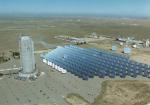 The 220 Mirrors of CRTF
4.10.1999
Even the largest of modern optical telescopes are small when compared with the light gathering power of the Central Receiver Test Facility (CRTF) located in New Mexico, USA. CRTF has 220 mirrors each over 7-meters in diameter all focused on a single tower.
 A Total Solar Eclipse Over China
5.08.2008
What's that black dot over the Sun? The Moon. This past weekend, the Sun went dark during the day as the Moon completely covered it. The total solar eclipse was visible over a thin swath of Earth extending from northern Canada to China.
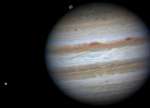 Jupiter Near Opposition
22.10.2011
On October 29 (UT), Jupiter, the solar system's largest planet, will be at opposition, opposite the Sun in planet Earth's sky, shining brightly and rising as the Sun sets. That configuration results...
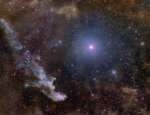 Rigel and the Witch Head Nebula
1.11.2012
Double, double toil and trouble; Fire burn, and cauldron bubble -- maybe Macbeth should have consulted the Witch Head Nebula. The suggestively shaped reflection nebula is associated with the bright star Rigel in the constellation Orion.
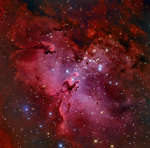 M16 and the Eagle Nebula
7.06.2014
A star cluster around 2 million years young, M16 is surrounded by natal clouds of dust and glowing gas also known as The Eagle Nebula. This beautifully detailed image of the region includes cosmic sculptures made famous in Hubble Space Telescope close-ups of the starforming complex.
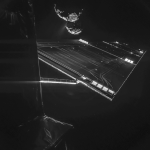 Rosetta s Selfie
16.10.2014
This Rosetta spacecraft selfie was snapped on October 7th. At the time the spacecraft was about 472 million kilometers from planet Earth, but only 16 kilometers from the surface of comet 67P/Churyumov-Gerasimenko. Looming beyond...
|
January February March April May June July August September October |
|||||||||||||||||||||||||||||||||||||||||||||||||