
|
You entered: image
 APOD: 2025 October 28 Б NGC 6995: The Bat Nebula
28.10.2025
Can you see the bat? It haunts this cosmic close-up of the eastern Veil Nebula. The Veil Nebula itself is a large supernova remnant, the expanding debris cloud from the death explosion of a massive star.
 Europa: The Latest From Galileo
17.01.1997
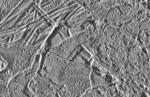
Today, NASA revealed recent results from the Galileo Probe's December 19th flyby of Europa, Jupiter's ice-covered moon - including this close-up image of fractured and frozen terrrain. The highest resolution picture ever made...
 Disappearing Clouds in Carina
30.06.2003
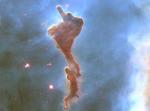
This dense cloud of gas and dust is being deleted. Likely, within a few million years, the intense light from bright stars will have boiled it away completely. Stars not yet formed in the molecular cloud's interior will then stop growing.
 Hyakutake: Comet Atmosphere
10.04.1998
The atmosphere of a comet comes and goes. Approaching the sun, it swells as material from the icy cometary nucleus is warmed and evaporated by increasing sunlight. Immense but tenuous and fleeting, the inner atmosphere or inner "coma" of comet Hyakutake is seen in this false color picture.
 Orion Nebula: The 2MASS View
12.06.1998
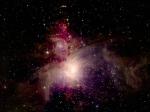
Few astronomical sights excite the imagination like the nearby stellar nursery known as the Orion Nebula. The Nebula's glowing gas surrounds hot young stars at the edge of an immense interstellar molecular cloud only 1,500 light-years away.
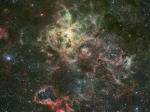 Tentacles of the Tarantula Nebula
22.08.2007
The largest, most violent star forming region known in the whole Local Group of galaxies lays in our neighboring galaxy the Large Magellanic Cloud (LMC). Were the Tarantula Nebula at the distance of the Orion Nebula -- a local star forming region -- it would take up fully half the sky.
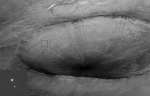 Descent of the Phoenix
30.05.2008
In this sweeping view, the 10 kilometer-wide crater Heimdall lies on the north polar plains of Mars. But the bright spot highlighted in the inset is the Phoenix lander parachuting toward the surface. The amazing picture was captured on May 25th by the HiRISE camera onboard the Mars Reconnaissance Orbiter.
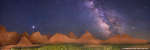 The Milky Way Over the Badlands
18.08.2009
Why take a picture of just the Badlands when you can take one that also shows the spectacular sky above it? Just such a picture, actually a digital stitched panorama of four images, was taken in late June near midnight, looking southwest.
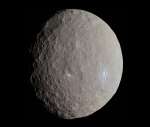 Dwarf Planet Ceres
4.02.2016
Dwarf planet Ceres is the largest object in the Solar System's main asteroid belt, with a diameter of about 950 kilometers (590 miles). Ceres is seen here in approximately true color, based on image data from the Dawn spacecraft recorded on May 4, 2015.
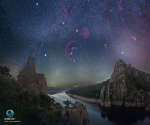 A Dark Winter Sky over MonfragЭe National Park in Spain
14.03.2017
You, too, can see a night sky like this. That is because MonfragЭe National Park in Spain, where this composite image was created, has recently had its night sky officially protected from potential future light pollution.
|
January February March April May June July August September |
|||||||||||||||||||||||||||||||||||||||||||||||||