
|
You entered: image
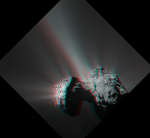 3D 67P
30.03.2019
Put on your red/cyan glasses and float next to the jagged and double-lobed nucleus of Churyumov-Gerasimenko, also known as Comet 67P. The stereo anaglyph was created by combining two images from the Rosetta spacecraft's narrow angle OSIRIS camera taken on July 25, 2015 from a distance of 184 kilometers.
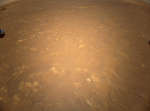 Perseverance from Ingenuity
1.05.2021
Flying at an altitude of 5 meters (just over 16 feet), on April 25 the Ingenuity helicopter snapped this sharp image. On its second flight above the surface of Mars, its color camera was looking back toward Ingenuity's current base at Wright Brothers Field and Octavia E.
 Apollo 12 and Surveyor 3
15.11.2024
Put on your red/blue glasses and gaze across the western Ocean of Storms on the surface of the Moon. The 3D anaglyph features Apollo 12 astronaut Pete Conrad visiting the Surveyor 3 spacecraft in November of 1969.
 APOD: 2025 September 21 Б Equinox Sunset
21.09.2025
Does the Sun set in the same direction every day? No, the direction of sunset depends on the time of the year. Although the Sun always sets approximately toward the west, on an equinox like today the Sun sets directly toward the west.
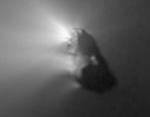 Halley s Nucleus: An Orbiting Iceberg
5.08.2000
What does a comet nucleus look like? Formed from the primordial stuff of the solar system, it is thought to resemble a very dirty iceberg. But for active comets, telescopic images only reveal the surrounding cloud of gas and dust, the comet's coma, and the characteristic cometary tails.
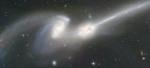 NGC 4676: When Mice Collide
6.05.2002
These two galaxies are pulling each other apart. Known as "The Mice" because they have such long tails, each spiral galaxy has likely already passed through the other and will probably collide again and again until they coalesce.
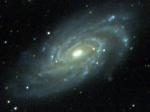 NGC 6070: First Light for Sloan
10.06.1998
The graceful spiral galaxy NGC 6070, 100 million light-years distant in the constellation Serpens, is helping astronomers celebrate "First Light" (the first test sky images) for an exciting new telescope built to perform the ambitious Sloan Digital Sky Survey.
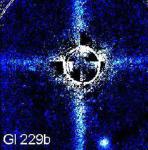 Brown Dwarf Gliese 229B
24.03.1999
The spot near the bottom is an image of an unusual type of object: a brown dwarf. A brown dwarf is sometimes called a "failed star" because it does not have enough mass to shine by nuclear fusion.
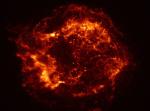 Chandras First Light: Cassiopeia A
27.08.1999
Cosmic wreckage from the detonation of a massive star is the subject of this official first image from NASA's Chandra X-ray Observatory. The supernova remnant, known as Cassiopeia A, was produced when a star exploded around 300 years ago in this northern sky constellation.
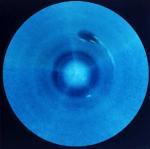 Southern Neptune
10.07.1999
Neptune, the Solar System's outermost gas giant planet, is 30 times farther from the Sun than Earth. Twelve years after a 1977 launch, Voyager 2 flew by Neptune and found surprising activity on a planet that receives only 3 percent as much sunlight as Jupiter.
|
January February March April May June July August September |
|||||||||||||||||||||||||||||||||||||||||||||||||