
|
You entered: image
 Arp 81: 100 Million Years Later
23.04.2014
From planet Earth, we see this strongly distorted pair of galaxies, cataloged as Arp 81, as they were only about 100 million years after their close encounter. The havoc wreaked by their mutual gravitational...
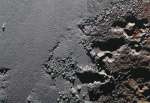 Sputnik Planum vs. Krun Macula
18.06.2016
Pluto's pitted plains meet rugged highlands in this stunning view. On the left lies a southeastern extent of the bright region still informally known as Sputnik Planum. At right the edge of a dark region, informally Krun Macula, rises some 2.5 kilometers above the icy plains.
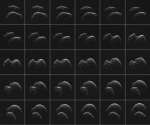 Asteroid 2014 JO25
20.04.2017
A day before its closest approach, asteroid 2014 JO25 was imaged by radar with the 70-meter antenna of NASA's Goldstone Deep Space Communications Complex in California. This grid of 30 radar images, top left to lower right, reveals the two-lobed shape of the asteroid that rotates about once every five hours.
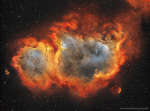 Glowing Elements in the Soul Nebula
21.08.2018
Stars are forming in the Soul of the Queen of Aethopia. More specifically, a large star forming region called the Soul Nebula (IC 1898) can be found in the direction of the constellation Cassiopeia, who Greek mythology credits as the vain wife of a King who long ago ruled lands surrounding the upper Nile river.
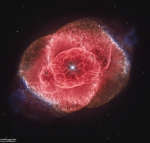 In the Center of the Cats Eye Nebula
10.07.2022
Three thousand light-years away, a dying star throws off shells of glowing gas. This image from the Hubble Space Telescope reveals the Cat's Eye Nebula (NGC 6543), to be one of the most complex planetary nebulae known.
 APOD: 2024 April 29 Б Comet, Planet, Moon
29.04.2024
Three bright objects satisfied seasoned stargazers of the western sky just after sunset earlier this month. The most familiar was the Moon, seen on the upper left in a crescent phase. The rest of the Moon was faintly visible by sunlight first reflected by the Earth.
 APOD: 2024 November 26 Б The Sombrero Galaxy from Webb and Hubble
26.11.2024
This floating ring is the size of a galaxy. In fact, it is a galaxy -- or at least part of one: the photogenic Sombrero Galaxy is one of the largest galaxies in the nearby Virgo Cluster of Galaxies.
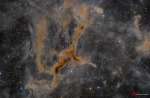 LDN 1295: The Giraffe Nebula
10.09.2026
What does this image look like to you? Many see a giraffe facing right, with neck stretched high and long legs mid-stride (but some may see a squirrel instead). The featured image shows LDN 1295, also called the Giraffe Nebula, in the constellation of the mythical queen of Aethiopia (Cassiopeia).
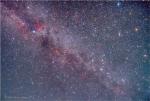 The Northern Milky Way
25.08.2003
Many of the stars in our home Milky Way Galaxy appear together as a dim band on the sky that passes nearly over the Earth's north and south poles. Pictured above is the part of our Galaxy that passes closest over the north pole.
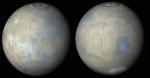 Mapping Mars
19.03.1999
This month, the Mars Global Surveyor (MGS) spacecraft began its primary mission to the red planet. Orbiting about once every two hours at an altitude of over 200 miles, instruments onboard MGS now regularly explore the Martian surface and atmosphere.
|
January February March April May June July August September |
|||||||||||||||||||||||||||||||||||||||||||||||||