
|
You entered: image
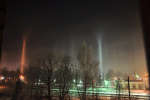 Unusual Light Pillars Over Latvia
12.01.2009
What's happening over that town? Close inspection shows these strange columns of light occur over bright lights, and so likely involve falling ice crystals reflecting back these lights. The reason why these pillars...
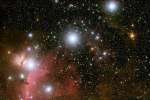 Orion s Belt
10.02.2009
Alnitak, Alnilam, and Mintaka, are the bright bluish stars from east to west (left to right) along the diagonal in this gorgeous cosmic vista. Otherwise known as the Belt of Orion, these three blue supergiant stars are hotter and much more massive than the Sun.
 Venus Near Inferior Conjunction
9.04.2009
This remarkable picture of a slender crescent Venus was made during daylight hours on March 26. Venus was then very near inferior conjunction, its closest approach to a point on a line directly between Earth and the Sun.
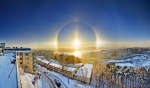 A Sun Halo Beyond Stockholm
10.01.2011
What's happened to the Sun? Sometimes it looks like the Sun is being viewed through a large lens. In the above case, however, there are actually millions of lenses: ice crystals. As water freezes in the upper atmosphere, small, flat, six-sided, ice crystals might be formed.
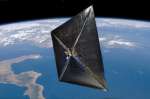 NanoSail D
28.01.2011
Featured in this artist's illustration, NASA's NanoSail-D finally unfurled a very thin, 10 square meter reflective sail on January 20th, becoming the first solar sail spacecraft in low Earth orbit. Often considered...
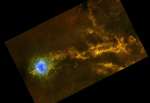 Herschel s Cocoon
19.08.2011
In this remarkable infrared skyscape of interstellar clouds adrift in the high flying constellation Cygnus, the eye is drawn to the Cocoon Nebula. Also known as IC5146, the dusty star forming region is shown...
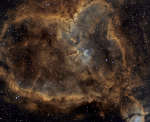 IC 1805: Light from the Heart
14.02.2014
Sprawling across almost 200 light-years, emission nebula IC 1805 is a mix of glowing interstellar gas and dark dust clouds about 7,500 light-years away in the Perseus spiral arm of our galaxy. Stars were born in this region whose nickname, the Heart Nebula, derives from its Valentine's-Day-appropriate shape.
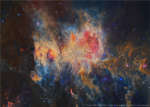 Infrared Orion from WISE
18.01.2015
The Great Nebula in Orion is an intriguing place. Visible to the unaided eye, it appears as a small fuzzy patch in the constellation of Orion. But this image, an illusory-color four-panel mosaic taken...
 Two Worlds One Sun
12.05.2015
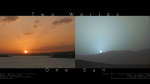
How different does sunset appear from Mars than from Earth? For comparison, two images of our common star were taken at sunset, one from Earth and one from Mars. These images were scaled to have same angular width and featured here side-by-side.
 Veil Nebula: Wisps of an Exploded Star
5.04.2021
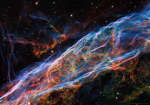
Wisps like this are all that remain visible of a Milky Way star. About 7,000 years ago that star exploded in a supernova leaving the Veil Nebula. At the time, the expanding cloud was likely as bright as a crescent Moon, remaining visible for weeks to people living at the dawn of recorded history.
|
January February March April May June July August September |
|||||||||||||||||||||||||||||||||||||||||||||||||