
|
You entered: image
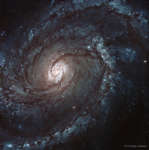 M100: A Grand Design Spiral Galaxy
10.02.2015
Majestic on a truly cosmic scale, M100 is appropriately known as a grand design spiral galaxy. It is a large galaxy of over 100 billion stars with well-defined spiral arms that is similar to our own Milky Way Galaxy.
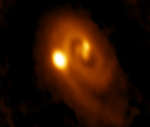 A Triple Star is Born
2.12.2016
A triple star system is forming, enshrouded within this dusty natal disk some 750 light-years away in the Perseus molecular cloud. Imaged at millimeter wavelengths by the Atacama Large Millimeter/submillimeter Array (ALMA) in Chile...
 NGC 2442: Galaxy in Volans
1.04.2023
Distorted galaxy NGC 2442 can be found in the southern constellation of the flying fish, (Piscis) Volans. Located about 50 million light-years away, the galaxy's two spiral arms extending from a pronounced central...
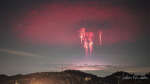 APOD: 2025 December 23 Б Red Sprites and Circular Elves Lightning over Italy
23.12.2025
What's happening in the sky? Lightning. The most commonly seen type of lightning involves flashes of bright white light between clouds. Over the past 50 years, though, other types of upper-atmospheric lightning have been confirmed, including tentacled red sprites and ringed ELVES.
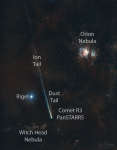 APOD: 2026 May 10 Б Comet R3 PanSTARRS and Orion
10.05.2026
Orion never had a sword like this. As Comet C/2025 R3 (PanSTARRS) heads out of the inner Solar System, it is putting on quite a show for long exposure cameras. Currently seen toward the constellation of Orion the Hunter, the distant Orion Nebula is visible on the upper right.
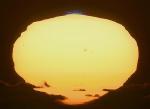 Blue Flash
9.01.2002
Difficult to observe, the momentary green flash above the rising or setting sun has been documented as a phenomenon caused by the atmospheric bending or refraction of sunlight. Like a weak prism, the Earth's atmosphere breaks white sunlight into colors, bending red colors slightly and green and blue colors through increasingly larger angles.
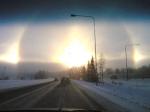 Driving Toward a Sun Halo
13.06.2006
What's happened to the Sun? Sometimes it looks like the Sun is being viewed through a large lens. In the above case, however, there are actually millions of lenses: ice crystals. As water freezes in the upper atmosphere, small, flat, six-sided, ice crystals might be formed.
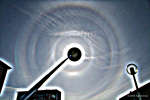 Pyramid Ice Crystal Halos Over Finland
18.06.2008
What if the atmosphere above you became one gigantic lens? This actually happens when a nearly transparent sheet of pyramid shaped ice crystals falls from the sky in a common orientation. These ice-crystals...
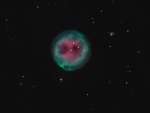 M97: The Owl Nebula
15.05.2009
The Owl Nebula is perched in the sky about 2,600 light-years away toward the bottom of the Big Dipper's bowl. Also cataloged as M97, the 97th object in Messier's well-known list, its round shape along with the placement of two large, dark "eyes" do suggest the face of a staring owl.
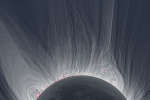 Detailed View of a Solar Eclipse Corona
16.03.2010
Only in the fleeting darkness of a total solar eclipse is the light of the solar corona easily visible. Normally overwhelmed by the bright solar disk, the expansive corona, the sun's outer atmosphere, is an alluring sight.
|
January February March April May June July August September |
|||||||||||||||||||||||||||||||||||||||||||||||||