
|
You entered: telescope
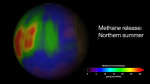 Methane Discovered in the Atmosphere of Mars
19.01.2009
Why is there methane on Mars? No one is sure. An important confirmation that methane exists in the atmosphere of Mars occurred last week, bolstering previous controversial claims made as early as 2003.
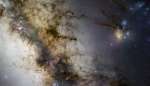 Gigagalaxy Zoom: Galactic Center
25.09.2009
From Sagittarius to Scorpius, the central Milky Way is a truly beautiful part of planet Earth's night sky. The gorgeous region is captured here, an expansive gigapixel mosaic of 52 fields spanning 34 by 20 degrees in 1200 individual images and 200 hours of exposure time.
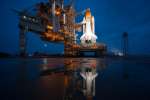 Atlantis Reflection
9.07.2011
Space shuttle orbiter Atlantis left planet Earth on Friday, July 8, embarking on the STS-135 mission to the International Space Station. The momentous launch was the final one in NASA's 30 year space shuttle program that began with the launch of the first reusable spacecraft on April 12, 1981.
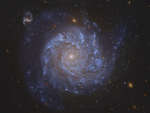 NGC 1309: Spiral Galaxy and Friends
16.01.2013
A gorgeous spiral galaxy some 100 million light-years distant, NGC 1309 lies on the banks of the constellation of the River (Eridanus). NGC 1309 spans about 30,000 light-years, making it about one third the size of our larger Milky Way galaxy.
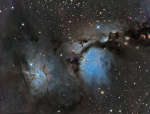 M78 and Reflecting Dust Clouds
26.03.2014
An eerie blue glow and ominous columns of dark dust highlight M78 and other bright reflection nebula in the constellation of Orion. The dark filamentary dust not only absorbs light, but also reflects the light of several bright blue stars that formed recently in the nebula.
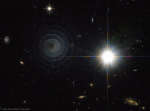 The Extraordinary Spiral in LL Pegasi
11.12.2016
What created the strange spiral structure on the left? No one is sure, although it is likely related to a star in a binary star system entering the planetary nebula phase, when its outer atmosphere is ejected.
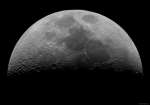 The Lunar X
1.03.2018
The striking X in this lunarscape is easily visible in binoculars or a small telescope, but not too many have seen it. The catch is, this lunar X is fleeting and only apparent in the hours before the Moon's first quarter phase.
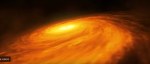 Animation: Spiral Disk around a Black Hole
20.08.2019
What would it look like to orbit a black hole? Many black holes are surrounded by swirling pools of gas known as accretion disks. These disks can be extremely hot, and much of the orbiting gas will eventually fall through the black hole's event horizon -- where it will never been seen again.
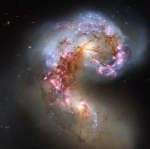 The Antennae Galaxies in Collision
3.12.2020
Sixty million light-years away toward the southerly constellation Corvus, these two large galaxies are colliding. The cosmic train wreck captured in stunning detail in this Hubble Space Telescope snapshot takes hundreds of millions of years to play out. Cataloged as NGC 4038 and NGC 4039, the galaxies' individual stars don't often collide though.
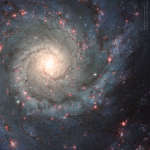 A Perfect Spiral
13.08.2021
If not perfect then this spiral galaxy is at least one of the most photogenic. An island universe of about 100 billion stars, 32 million light-years away toward the constellation Pisces, M74 presents a gorgeous face-on view.
|
January February March April May June July August September October |
|||||||||||||||||||||||||||||||||||||||||||||||||