
|
You entered: telescope
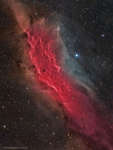 The California Nebula
11.01.2016
What's California doing in space? Drifting through the Orion Arm of the spiral Milky Way Galaxy, this cosmic cloud by chance echoes the outline of California on the west coast of the United States.
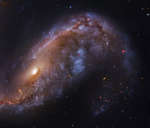 NGC 2442: Galaxy in Volans
16.08.2017
Distorted galaxy NGC 2442 can be found in the southern constellation of the flying fish, (Piscis) Volans. Located about 50 million light-years away, the galaxy's two spiral arms extending from a pronounced central bar have a hook-like appearance in wide-field images.
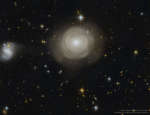 Shells of Stars in Elliptical Galaxy PGC 42871
28.10.2018
How do galaxies grow? To help find out, the Hubble Space Telescope was deployed to image the unusual elliptical galaxy PGC 42871. How this galaxy came to be surrounded by numerous shells of stars may give clues about how it evolved.
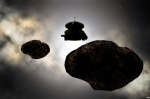 New Horizons at Ultima Thule
28.12.2018
When we celebrate the start of 2019, on January 1 the New Horizons spacecraft will flyby Ultima Thule. A world of the Kuiper belt 6.5 billion kilometers from the Sun, the nickname Ultima Thule (catalog designation 2014 MU69) fittingly means "beyond the known world".
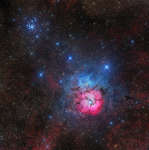 Messier 20 and 21
29.12.2019
The beautiful Trifid Nebula, also known as Messier 20, is easy to find with a small telescope in the nebula rich constellation Sagittarius. About 5,000 light-years away, the colorful study in cosmic contrasts shares this well-composed, nearly 1 degree wide field with open star cluster Messier 21 (top left).
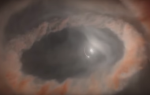 GW Orionis: A Star System with Titled Rings
28.09.2020
Triple star system GW Orionis appears to demonstrate that planets can form and orbit in multiple planes. In contrast, all the planets and moons in our Solar System orbit in nearly the same plane. The picturesque system has three prominent stars, a warped disk, and inner tilted rings of gas and grit.
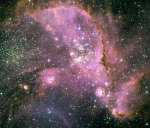 Young Stars of NGC 346
11.05.2022
The massive stars of NGC 346 are short lived, but very energetic. The star cluster is embedded in the largest star forming region in the Small Magellanic Cloud, some 210,000 light-years distant. Their...
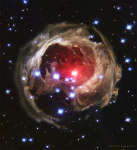 Light Echoes from V838 Mon
25.06.2022
What caused this outburst of V838 Mon? For reasons unknown, star V838 Mon's outer surface suddenly greatly expanded with the result that it became one of the brighter stars in the Milky Way Galaxy in early 2002. Then, just as suddenly, it shrunk and faded.
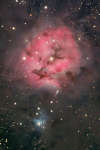 IC 5146: The Cocoon Nebula
26.08.2022
Inside the Cocoon Nebula is a newly developing cluster of stars. Cataloged as IC 5146, the beautiful nebula is nearly 15 light-years wide. Climbing high in northern summer night skies, it's located some 4,000 light years away toward the constellation Cygnus the Swan.
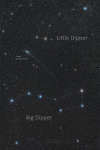 APOD: 2023 February 7 Б A Comet and Two Dippers
6.02.2023
Can you still see the comet? Yes. Even as C/2022 E3 (ZTF) fades, there is still time to see it if you know where and when to look. Geometrically, Comet ZTF has passed its closest to both the Sun and the Earth and is now headed back to the outer Solar System.
|
January February March April May June July August September October |
|||||||||||||||||||||||||||||||||||||||||||||||||