
|
You entered: light
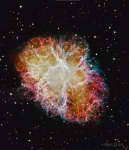 APOD: 2025 December 29 Б M1: The Crab Nebula
29.12.2025
This is the mess that is left when a star explodes. The Crab Nebula, the result of a supernova seen in 1054 AD, is filled with mysterious filaments. The filaments are not only tremendously...
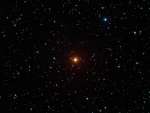 La Superba
18.12.2008
Y Canum Venaticorum (Y CVn) is a very rare star in planet Earth's night sky. It's also very red, exhibiting such a remarkable spectrum of light, 19th century astronomer Angelo Secchi dubbed it La Superba.
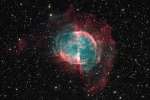 M27: Not a Comet
26.08.2010
While hunting for comets in the skies above 18th century France, astronomer Charles Messier diligently kept a list of the things he encountered that were definitely not comets. This is number 27 on his now famous not-a-comet list.
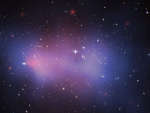 The El Gordo Massive Galaxy Cluster
22.04.2014
It is bigger than a bread box. In fact, it is much bigger than all bread boxes put together. Galaxy cluster ACT-CL J0102-4915 is one of the largest and most massive objects known. Dubbed...
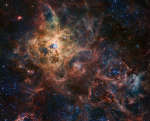 The Tarantula Nebula
26.02.2016
The Tarantula Nebula is more than a thousand light-years in diameter, a giant star forming region within nearby satellite galaxy the Large Magellanic Cloud, about 180 thousand light-years away. The largest, most violent star...
 Webb's First Deep Field
15.07.2023
This stunning infrared image was released one year ago as the James Webb Space Telescope began its exploration of the cosmos. The view of the early Universe toward the southern constellation Volans was achieved in 12.5 hours of exposure with Webb's NIRCam instrument.
 APOD: 2023 September 6 Б HESS Telescopes Explore the High Energy Sky
6.09.2023
They may look like modern mechanical dinosaurs, but they are enormous swiveling eyes that watch the sky. The High Energy Stereoscopic System (H.E.S.S.) Observatory is composed of four 12-meter reflecting-mirror telescopes surrounding a larger telescope housing a 28-meter mirror.
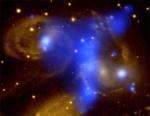 X rays from Stephan s Quintet
12.08.2003
Stephan's Quintet is a picturesque but clearly troubled grouping of galaxies about 300 million light-years away toward the high-flying constellation Pegasus. Spanning over 200,000 light-years at that distance, this composite false-color image...
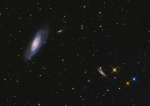 A View Toward M106
1.05.2020
Big, bright, beautiful spiral, Messier 106 dominates this cosmic vista. The nearly two degree wide telescopic field of view looks toward the well-trained constellation Canes Venatici, near the handle of the Big Dipper. Also...
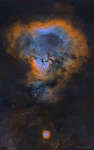 NGC 7822: Cosmic Question Mark
13.10.2021
It may look like a huge cosmic question mark, but the big question really is how does the bright gas and dark dust tell this nebula's history of star formation. At the edge...
|
January February March April May June July August September October |
|||||||||||||||||||||||||||||||||||||||||||||||||