
|
You entered: light
 The Double Cluster in Perseus
7.07.2023
This pretty starfield spans about three full moons (1.5 degrees) across the heroic northern constellation of Perseus. It holds the famous pair of open star clusters, h and Chi Persei. Also cataloged...
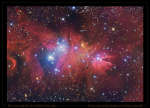 A Fox Fur, a Unicorn, and a Christmas Tree
6.04.2010
What do the following things have in common: a cone, the fur of a fox, and a Christmas tree? Answer: they all occur in the constellation of the unicorn (Monoceros). Pictured above...
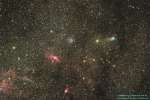 Comet Lemmon and the Deep Sky
20.07.2013
Now sweeping high above the ecliptic plane, Comet Lemmon has faded dramatically in planet Earth's night sky as it heads for the outer solar system. Some 16 light-minutes (2 AU) from...
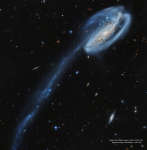 Arp 188 and the Tadpole's Tail
11.12.2018
Why does this galaxy have such a long tail? In this stunning vista, based on image data from the Hubble Legacy Archive, distant galaxies form a dramatic backdrop for disrupted spiral galaxy Arp 188, the Tadpole Galaxy. The cosmic tadpole is a mere 420 million light-years distant toward the northern constellation of the Dragon (Draco).
 Messier 101
27.11.2021
Big, beautiful spiral galaxy M101 is one of the last entries in Charles Messier's famous catalog, but definitely not one of the least. About 170,000 light-years across, this galaxy is enormous, almost twice the size of our own Milky Way.
 Messier 101
2.06.2023
Big, beautiful spiral galaxy M101 is one of the last entries in Charles Messier's famous catalog, but definitely not one of the least. About 170,000 light-years across, this galaxy is enormous, almost twice the size of our own Milky Way.
 Messier 101
16.05.2025
Big, beautiful spiral galaxy M101 is one of the last entries in Charles Messier's famous catalog, but definitely not one of the least. About 170,000 light-years across, this galaxy is enormous, almost twice the size of our own Milky Way.
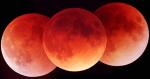 A Lunar Eclipse in Three Exposures
25.01.2000
Our Moon turned red last week. The reason was that during the night of January 20, a total lunar eclipse occurred. The above digitally superimposed photographs captured the Moon three times during this lunar...
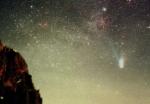 Hale-Bopp Brightest Comet This Decade
13.03.1997
The Great Comet of 1997 is now brighter than the Great Comet of 1996 ever was. In fact, it is brighter than almost every star in the sky. Yet Comet Hale-Bopp is still about two weeks away from maximum light.
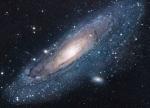 M31: The Andromeda Galaxy
18.07.2004
Andromeda is the nearest major galaxy to our own Milky Way Galaxy. Our Galaxy is thought to look much like Andromeda. Together these two galaxies dominate the Local Group of galaxies. The diffuse light from Andromeda is caused by the hundreds of billions of stars that compose it.
|
January February March April May June July August September October |
|||||||||||||||||||||||||||||||||||||||||||||||||