
|
You entered: light
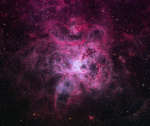 The Tarantula Nebula
17.11.2018
The Tarantula Nebula, also known as 30 Doradus, is more than a thousand light-years in diameter, a giant star forming region within nearby satellite galaxy the Large Magellanic Cloud. About 180 thousand light-years away, it's the largest, most violent star forming region known in the whole Local Group of galaxies.
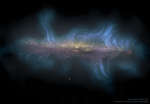 The Vertical Magnetic Field of NGC 5775
27.01.2021
How far do magnetic fields extend up and out of spiral galaxies? For decades astronomers knew only that some spiral galaxies had magnetic fields. However, after NRAO's Very Large Array (VLA) radio telescope...
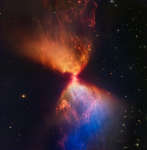 The Protostar within L1527
18.11.2022
The protostar within dark cloud L1527 is a mere 100,000 years old, still embedded in the cloud of gas and dust that feeds its growth. In this NIRCam image from the James Webb...
 APOD: 2024 July 23 Б The Crab Nebula from Visible to X Ray
23.07.2024
What powers the Crab Nebula? A city-sized magnetized neutron star spinning around 30 times a second. Known as the Crab Pulsar, it is the bright spot in the center of the gaseous swirl at the nebula's core.
 APOD: 2025 April 14 Б The Galactic Center in Radio from MeerKAT
14.04.2025
What's happening at the center of our galaxy? It's hard to tell with optical telescopes since visible light is blocked by intervening interstellar dust. In other bands of light, though, such as radio, the galactic center can be imaged and shows itself to be quite an interesting and active place.
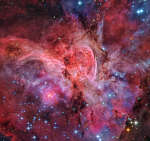 Carina Nebula Close Up
15.02.2020
A jewel of the southern sky, the Great Carina Nebula, also known as NGC 3372, spans over 300 light-years, one of our galaxy's largest star forming regions. Like the smaller, more northerly Great...
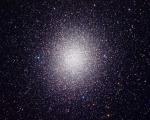 Millions of Stars in Omega Centauri
16.04.2002
Pictured above is the largest ball of stars in our Galaxy. About 10 million stars orbit the center of this globular cluster - named Omega Centauri - as this giant globular cluster orbits our Galactic center.
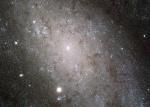 The Stars of NGC 300
16.04.2004
Like grains of sand on a cosmic beach, individual stars of large spiral galaxy NGC 300 are resolved in this sharp image from the Hubble Space Telescope's Advanced Camera for Surveys (ACS).
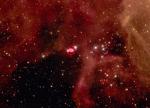 A Supernova Starfield
9.02.1999
Bright stars don't last forever. A bright star similar to others in this field exploded in a spectacular supernova that was witnessed on Earth in 1987. The result is visible even today as unusual rings and glowing gas. The above picture is a composite of recent images taken over several years.
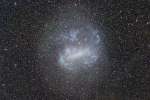 A Large Magellanic Cloud Deep Field
9.04.2008
Is this a spiral galaxy? No. Actually, it is the Large Magellanic Cloud (LMC), the largest satellite galaxy of our own Milky Way Galaxy. The LMC is classified as a dwarf irregular galaxy because of its normally chaotic appearance. In this deep and wide exposure, however, the full extent of the LMC becomes visible.
|
January February March April May June July August September October |
|||||||||||||||||||||||||||||||||||||||||||||||||