
|
You entered: light
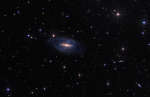 Polar Ring Galaxy NGC 2685
14.03.2014
NGC 2685 is a confirmed polar ring galaxy - a rare type of galaxy with stars, gas and dust orbiting in rings perpendicular to the plane of a flat galactic disk. The bizarre configuration could...
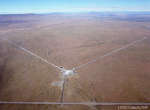 Advanced LIGO: Gravitational Wave Detectors Upgraded
7.02.2016
Accelerate a charge and you'll get electromagnetic radiation: light. But accelerate any mass and you'll get gravitational radiation. Light is seen all the time, but, so far, a confirmed direct detection of gravitational radiation has been elusive.
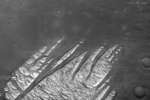 White Rock Fingers on Mars
15.02.2016
What caused this unusual light rock formation on Mars? Intrigued by the possibility that they could be salt deposits left over as an ancient lakebed dried-up, detailed studies of these fingers now indicate a more mundane possibility: volcanic ash. Studying the exact color of the formation indicated the possible volcanic origin.
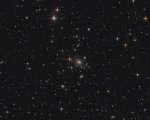 Galaxy Cluster Abell 2666
10.03.2017
The galaxies of Abell 2666 lie far beyond the Milky Way, some 340 million light-years distant toward the high flying constellation Pegasus. Framed in this sharp telescopic image, the pretty cluster galaxies are gathered behind scattered, spiky, Milky Way stars.
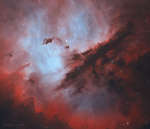 Dust Clouds of the Pacman Nebula
10.08.2022
Stars can create huge and intricate dust sculptures from the dense and dark molecular clouds from which they are born. The tools the stars use to carve their detailed works are high energy light and fast stellar winds.
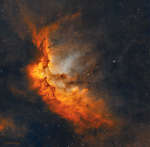 NGC 7380: The Wizard Nebula
14.11.2022
What powers are being wielded in the Wizard Nebula? Gravitation strong enough to form stars, and stellar winds and radiations powerful enough to create and dissolve towers of gas. Located only 8,000 light years away, the Wizard nebula, featured here, surrounds developing open star cluster NGC 7380.
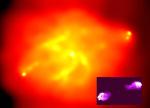 X Ray Cygnus A
10.11.2000
Amazingly detailed, this false-color x-ray image is centered on the galaxy Cygnus A. Recorded by the orbiting Chandra Observatory, Cygnus A is seen here as a spectacular high energy x-ray source. But it is actually more famous at the low energy end of the electromagnetic spectrum as one of the brightest celestial radio sources.
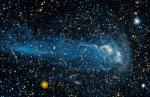 The Tail of a Wonderful Star
17.08.2007
To seventeenth century astronomers, Omicron Ceti or Mira was known as a wonderful star, a star whose brightness could change dramatically in the course of about 11 months. Mira is now seen as the archetype of an entire class of long-period variable stars.
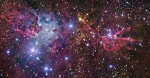 Fox Fur, a Unicorn, and a Christmas Tree
25.12.2008
Clouds of glowing hydrogen gas fill this colorful skyscape in the faint but fanciful constellation Monoceros, the Unicorn. A star forming region cataloged as NGC 2264, the complex jumble of cosmic gas and dust...
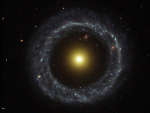 Hoags Object: A Strange Ring Galaxy
28.07.2013
Is this one galaxy or two? This question came to light in 1950 when astronomer Art Hoag chanced upon this unusual extragalactic object. On the outside is a ring dominated by bright blue stars, while near the center lies a ball of much redder stars that are likely much older.
|
January February March April May June July August September October |
|||||||||||||||||||||||||||||||||||||||||||||||||