
|
You entered: nucleus
 APOD: 2024 September 8 Б M31: The Andromeda Galaxy
7.09.2024
The most distant object easily visible to the unaided eye is M31, the great Andromeda Galaxy. Even at some two and a half million light-years distant, this immense spiral galaxy -- spanning over 200,000 light years -- is visible, although as a faint, nebulous cloud in the constellation Andromeda.
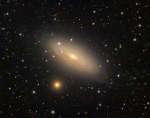 Spiral Galaxy NGC 2841
2.03.2022
A mere 46 million light-years distant, spiral galaxy NGC 2841 can be found in the northern constellation of Ursa Major. This deep view of the gorgeous island universe was captured during 32 clear nights in November, December 2021 and January 2022. It shows off a striking yellow nucleus, galactic disk, and faint outer regions.
 APOD: 2023 August 29 Б Unusual Spiral Galaxy M66 from Webb
28.08.2023
Why isn't spiral galaxy M66 symmetric? Usually, density waves of gas, dust, and newly formed stars circle a spiral galaxy's center and create a nearly symmetric galaxy. The differences between...
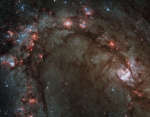 M83s Center from Refurbished Hubble
15.11.2009
What's happening at the center of spiral galaxy M83? Just about everything, from the looks of it. M83 is one of the closest spiral galaxies to our own Milky Way Galaxy and from a distance of 15 million light-years, appears to be relatively normal.
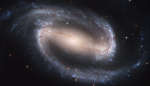 Barred Spiral Galaxy NGC 1300
8.01.2016
Big, beautiful, barred spiral galaxy NGC 1300 lies some 70 million light-years away on the banks of the constellation Eridanus. This Hubble Space Telescope composite view of the gorgeous island universe is one of the largest Hubble images ever made of a complete galaxy.
 Barred Spiral Galaxy NGC 1300
11.01.2005
Big, beautiful barred spiral galaxy NGC 1300 lies some 70 million light-years away on the banks of the constellation Eridanus. This Hubble Space Telescope composite view of the gorgeous island universe was released...
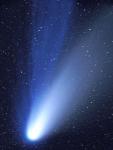 The Dust and Ion Tales of Comet Hale-Bopp
22.05.2005
In 1997, Comet Hale-Bopp's intrinsic brightness exceeded any comet since 1811. Since it peaked on the other side of the Earth's orbit, however, the comet appeared only brighter than any comet in two decades. Visible above are the two tails shed by Comet Hale-Bopp.
 APOD: 2025 February 2 Б Comet G3 ATLAS Disintegrates
1.02.2025
What's happening to Comet G3 ATLAS? After passing near the Sun in mid-January, the head of the comet has become dimmer and dimmer. By late January, Comet C/2024 G3 (ATLAS) had become a headless wonder -- even though it continued to show impressive tails after sunset in the skies of Earth's Southern Hemisphere.
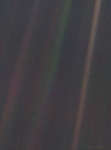 The Largest Rock in our Solar System
31.12.2022
There, that dot on the right, that's the largest rock known in our Solar System. It is larger than every known asteroid, moon, and comet nucleus. It is larger than any other local rocky planet.
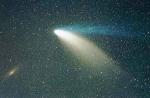 Hale-Bopp and Andromeda
1.04.1997
Which is closer: the comet or the galaxy? Answer: the comet. In its trek through the inner Solar System, Comet Hale-Bopp has passed nearly in front of the Andromeda Galaxy (M31), seen on the lower left.
|
January February March April May June July August September |
|||||||||||||||||||||||||||||||||||||||||||||||||