
|
You entered: temperature
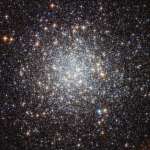 Messier 9 Close Up
23.03.2012
Renown 18th century astronomer Charles Messier described this 9th entry in his famous astronomical catalog as "Nebula, without star, in the right leg of Ophiuchus ...". But Messier 9 (M9) does have stars, known to modern astronomers as a globular cluster of over 300,000 stars within a diameter of about 90 light-years.
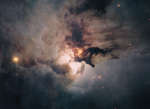 In the Center of the Lagoon Nebula
20.08.2014
The center of the Lagoon Nebula is a whirlwind of spectacular star formation. Visible near the image center, at least two long funnel-shaped clouds, each roughly half a light-year long, have been formed by extreme stellar winds and intense energetic starlight. The tremendously bright nearby star, Hershel 36, lights the area.
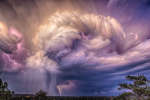 Lightning over Colorado
27.09.2020
Have you ever watched a lightning storm in awe? Join the crowd. Oddly, details about how lightning is produced remains a topic of research. What is known is that updrafts carry light ice crystals into collisions with larger and softer ice balls, causing the smaller crystals to become positively charged.
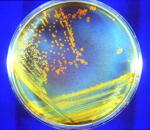 D rad Bacteria: Candidate Astronauts
22.01.2006
These bacteria could survive on another planet. In an Earth lab, Deinococcus radiodurans (D. rad) survive extreme levels of radiation, extreme temperatures, dehydration, and exposure to genotoxic chemicals. Amazingly, they even have the ability to repair their own DNA, usually with 48 hours. Known as an extremophile, bacteria such as D.
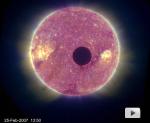 Lunar Transit from STEREO
3.03.2007
A million miles from planet Earth, last weekend the STEREO B spacecraft found itself in the shadow of the Moon. So, looking toward the Sun, extreme ultraviolet cameras onboard STEREO B were able to record a stunning movie of a lunar transit (aka solar eclipse), as the Moon tracked across the solar disk.
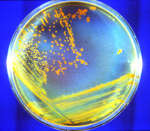 D. rad Bacteria: Candidate Astronauts
30.08.2009
These bacteria could survive on another planet. In an Earth lab, Deinococcus radiodurans (D. rad) survive extreme levels of radiation, extreme temperatures, dehydration, and exposure to genotoxic chemicals. Amazingly, they even have the ability to repair their own DNA, usually with 48 hours. Known as an extremophile, bacteria such as D.
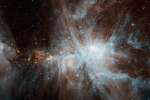 Spitzer s Orion
10.04.2010
Few cosmic vistas excite the imagination like the Orion Nebula, an immense stellar nursery some 1,500 light-years away. Spanning about 40 light-years across the region, this new infrared image from the Spitzer Space...
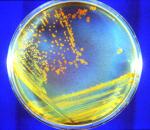 D rad Bacteria: Candidate Astronauts
25.04.2004
These bacteria could survive on another planet. In an Earth lab, Deinococcus radiodurans (D. rad) survive extreme levels of radiation, extreme temperatures, dehydration, and exposure to genotoxic chemicals. Amazingly, they even have the ability to repair their own DNA, usually with 48 hours. Known as an extremophile, bacteria such as D.
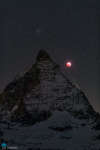 Matterhorn, Moon, and Meteor
24.01.2019
Fans of planet Earth probably recognize the Matterhorn in the foreground of this night skyscape. Famed in mountaineering history, the 4,478 meter Alpine mountain stands next to the totally eclipsed Moon. In spite...
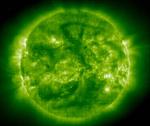 S is for Sun
21.03.2002
Taken yesterday from the SOHO spacecraft, this false-color image shows the active Sun near the March Equinox, the beginning of Fall in the south and Spring in the northern hemisphere. Recorded in a band...
|
January February March April May June July August September October |
|||||||||||||||||||||||||||||||||||||||||||||||||