
|
You entered: temperature
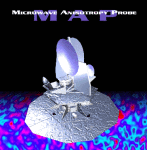 NASA Mission to MAP the Universe
15.04.1996
What is our universe made of? How rapidly is our universe expanding? When did galaxies form? These questions, among the most important and baffling to astronomers since the beginning of the modern astronomical era, might well be answered by a new space satellite mission.
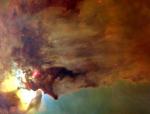 In the Center of the Lagoon Nebula
3.03.2003
The center of the Lagoon Nebula is busy with the awesome spectacle of star formation. Visible in the lower left, at least two long funnel-shaped clouds, each roughly half a light-year long, have been formed by extreme stellar winds and intense energetic starlight. The tremendously bright nearby star, Hershel 36, lights the area.
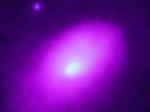 Abell 2142: Clash of the Galaxy Clusters
5.03.2000
Over the course of billions of years, whole clusters of galaxies merge. Above is an X-ray image of Abell 2142, the result of the collision of two huge clusters of galaxies, and one of the most massive objects known in the universe.
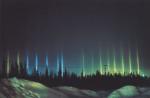 Colorful Light Pillars
2.09.2002
How can an aurora appear so near the ground? Pictured above are not aurora but nearby light pillars, a local phenomenon that can appear as a distant one. In most places on Earth...
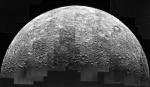 Mercury: A Cratered Inferno
1.01.1999
Mercury's surface looks similar to our Moon's. Each is heavily cratered and made of rock. Mercury's diameter is about 4800 km, while the Moon's is slightly less at about 3500 km (compared with about 12,700 km for the Earth). But Mercury is unique in many ways.
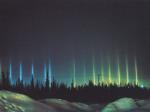 Colorful Light Pillars
4.03.2006
How can an aurora appear so near the ground? Pictured above are not aurora but nearby light pillars, a local phenomenon that can appear as a distant one. In most places on Earth...
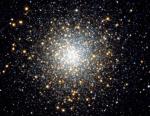 Hydrogen, Helium, and the Stars of M10
30.06.2001
Stars like the Sun use hydrogen for fuel, "burning" hydrogen into helium at their cores through nuclear fusion. But what happens when that hydrogen runs out? For a while, hydrogen burns in a shell surrounding the stellar core and the star expands to become a red giant.
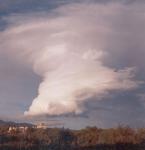 Anvil Cloud Over Sicily
17.02.2004
The cloud poses no danger to the building. Appearing to float above a remote monastery in Sicily, Italy, the anvil cloud's shape shows several classic cloud features. The cloud itself is composed of millions of very small droplets of water and ice.
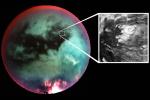 Titan s Cryovolcano
10.06.2005
Investigators suspect the domed feature detailed above is an ice volcano, or cryovolcano, seen in infrared light through the hazy atmosphere on Saturn's moon Titan. Since Titan's surface temperature is around -180...
 SDO: The Extreme Ultraviolet Sun
23.04.2010
Don't panic, the Sun has not gone wild. But this wild-looking portrait of the nearest star to planet Earth was made on March 30th by the recently launched Solar Dynamics Observatory (SDO). Shown in false-color, the composite view covers extreme ultraviolet wavelengths and traces hot plasma at temperatures approaching 1 million kelvins.
|
January February March April May June July August September October |
|||||||||||||||||||||||||||||||||||||||||||||||||