
|
You entered: temperature
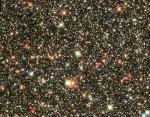 Sagittarius Star Cloud
20.05.2001
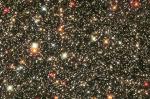
Stars come in all different colors. The color of a star indicates its surface temperature, an important property used to assign each star a spectral type. Most stars in the above Sagittarius Star Cloud are orange or red and relatively faint, as our Sun would appear.
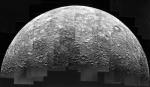 Mercury: A Cratered Inferno
19.08.2001
Mercury's surface looks similar to our Moon's. Each is heavily cratered and made of rock. Mercury's diameter is about 4800 km, while the Moon's is slightly less at about 3500 km (compared with about 12,700 km for the Earth). But Mercury is unique in many ways.
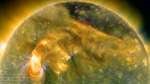 The Not So Quiet Sun
6.08.2010
After a long solar minimum, the Sun is no longer so quiet. On August 1, this extreme ultraviolet snapshot of the Sun from the Solar Dynanimcs Observatory captured a complex burst of activity playing across the Sun's northern hemisphere.
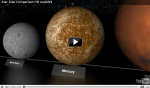 Star Size Comparisons
22.02.2011
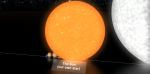
How big is our Sun compared to other stars? In a dramatic and popular video featured on YouTube, the relative sizes of planets and stars are shown from smallest to largest. The above video starts with Earth's Moon and progresses through increasingly larger planets in our Solar System.
 Star Size Comparisons
6.06.2013
How big is our Sun compared to other stars? In a dramatic and popular video featured on YouTube, the relative sizes of planets and stars are shown from smallest to largest. The above video starts with Earth's Moon and progresses through increasingly larger planets in our Solar System.
 Night and Day in Melas Chasma on Mars
16.12.2002
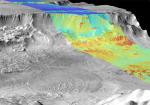
What types of terrain are found on Mars? Part of the answer comes from thermal imaging by the robot spacecraft 2001 Mars Odyssey currently orbiting Mars. The above picture is a superposition of two infrared images, a black and white image taken during Martian daylight and a false-color image taken at night.
 Sagittarius Star Cloud
13.01.1999
Stars come in all different colors. The color of a star indicates its surface temperature, an important property used to assign each star a spectral type. Most stars in the above Sagittarius Star Cloud are orange or red and relatively faint, as our Sun would appear.
 Contrail Clutter over Georgia
13.10.2004
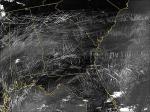
Artificial clouds made by humans may become so common they change the Earth's climate. The long thin cloud streaks that dominate the above satellite photograph of Georgia are contrails, cirrus clouds created by airplanes. The exhaust of an airplane engine can create a contrail by saturating the surrounding air with extra moisture.
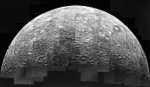 Mercury: A Cratered Inferno
12.09.1996
Mercury's surface looks similar to our Moon's. Each is heavily cratered and made of rock. Mercury's diameter is about 4800 km, while the Moon's is slightly less at about 3500 km (compared with about 12,700 km for the Earth). But Mercury is unique in many ways.
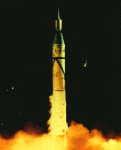 The First Explorer
6.02.1999
The first US spacecraft was Explorer 1. The cylindrical 30 pound satellite was launched (above) as the fourth stage of a Jupiter-C rocket (a modified US Army Redstone ballistic missile) and achieved orbit on January 31, 1958.
|
January February March April May June July August September October |
|||||||||||||||||||||||||||||||||||||||||||||||||