
|
You entered: clouds
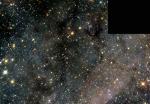 A Magellanic Starfield
13.12.1999
Stars of many types and colors are visible in this Hubble Space Telescope vista of the Large Magellanic Cloud (LMC). Over 10,000 stars are visible -- the brightest of which are giant stars. Were our Sun 170,000 light-years distant and among these stars, it would hardly be discernable.
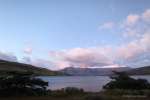 Moonbow and Rainbows Over Patagonia
10.08.2009
Have you ever seen a moonbow? Just as rainbows are lit by the Sun, moonbows are lit by the Moon. Since the Sun is so much brighter than the Moon, sunlit rainbows are much brighter and more commonly seen than moonbows.
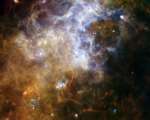 Herschel Views the Milky Way
2.09.2011
With a 3.5 meter diameter mirror, larger than the Hubble Space Telescope, ESA's Herschel Space Observatory explores the Universe at infrared wavelengths. Herschel is named for German-born British astronomer Frederick William Herschel who discovered infrared light over 200 years ago.
 Comet Between Fireworks and Lightning
10.11.2013
Sometimes the sky itself is the best show in town. In January 2007, people from Perth, Australia gathered on a local beach to watch a sky light up with delights near and far. Nearby, fireworks exploded as part of Australia Day celebrations. On the far right, lightning from a thunderstorm flashed in the distance.
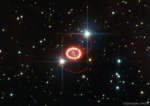 The Mysterious Rings of Supernova 1987A
5.03.2017
What's causing those odd rings in supernova 1987A? Thirty years ago, in 1987, the brightest supernova in recent history was seen in the Large Magellanic Cloud. At the center of the featured picture is an object central to the remains of the violent stellar explosion.
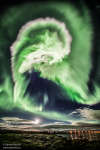 A Spiral Aurora over Iceland
12.09.2021
What's happened to the sky? Aurora! Captured in 2015, this aurora was noted by Icelanders for its great brightness and quick development. The aurora resulted from a solar storm, with high energy particles bursting out from the Sun and through a crack in Earth's protective magnetosphere a few days later.
 APOD: 2023 September 26 Б IC 4592: The Blue Horsehead Reflection Nebula
26.09.2023
Do you see the horse's head? What you are seeing is not the famous Horsehead nebula toward Orion, but rather a fainter nebula that only takes on a familiar form with deeper imaging. The main part of the here-imaged molecular cloud complex is reflection nebula IC 4592.
 APOD: 2024 March 13 Б The Seagull Nebula
13.03.2024
A broad expanse of glowing gas and dust presents a bird-like visage to astronomers from planet Earth, suggesting its popular moniker: the Seagull Nebula. This portrait of the cosmic bird covers a 1.6-degree...
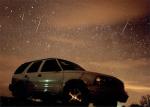 Leonids from the Road
26.11.2001
Sometimes you just have to stop and watch the meteors. In the early morning hours of November 18, a band of eleven people searched for a flat and cloudless site to see the 2001 Leonids Meteor Shower.
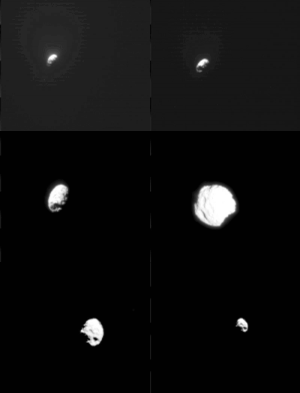 STARDUST Flyby of Comet Wild 2
19.01.2004
Flying past a comet nucleus is dangerous. On January 2, the robot spacecraft STARDUST became one of the first to plow through the surrounding cloud of dust and grit to photograph the very heart of a comet.
|
January February March April May June July August September October |
|||||||||||||||||||||||||||||||||||||||||||||||||