
|
You entered: clouds
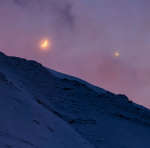 Conjunction after Sunset
19.12.2020
How close will Jupiter and Saturn be at their Great Conjunction? Consider this beautiful triple conjunction of Moon, Jupiter and Saturn captured through clouds in the wintry twilight. The telephoto view looks toward the western horizon and the Alborz Mountains in Iran after sunset on December 17.
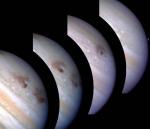 Jupiter Swallows Comet Shoemaker Levy 9
5.11.2000
What happens when a comet encounters a planet? If the planet has a rocky surface, a huge impact feature will form. A giant planet like Jupiter, however, is mostly gas. When Comet Shoemaker-Levy 9 struck Jupiter in 1994, each piece was swallowed into the vast Jovian atmosphere.
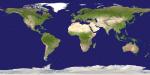 Earth in True Color
5.03.2002
Here are the true colors of planet Earth. Blue oceans dominate our world, while areas of green forest, brown mountains, tan desert, and white ice are also prominent. Oceans appear blue not only because water itself is blue but also because seawater frequently scatters light from a blue sky.
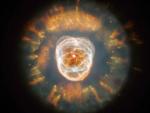 The Eskimo Nebula from Hubble
7.04.2002
In 1787, astronomer William Herschel discovered the Eskimo Nebula. From the ground, NGC 2392 resembles a person's head surrounded by a parka hood. In 2000, the Hubble Space Telescope imaged the Eskimo Nebula. From space, the nebula displays gas clouds so complex they are not fully understood.
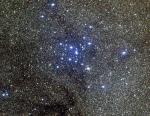 The M7 Open Star Cluster in Scorpius
5.05.2002
M7 is one of the most prominent open clusters of stars on the sky. The cluster, dominated by bright blue stars, can be seen with the naked eye in a dark sky in the tail of the constellation of Scorpius.
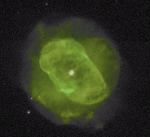 NGC 5882: A Small Planetary Nebula
28.08.1996
Will most stars one day look like this? Pictured above is the planetary nebula NGC 5882, captured by the Hubble Space Telescope. Although planetary nebulae can appear similar to planets like Uranus and Neptune, they are actually gas clouds surrounding stars typically hundreds of light years away.
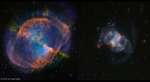 The Dumbells
17.12.2008
These two nebulae are cataloged as M27 (left) and M76, popularly known as The Dumbbell and the Little Dumbbell. Not intended to indicate substandard mental prowess, their popular names refer to their similar, dumbbell or hourglass shapes.
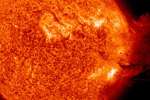 The Sun Unleashed
10.06.2011
On June 7, the Sun unleashed only a medium sized solar flare as rotation carried active regions of sunpots toward the solar limb. But that flare was followed by an astounding gush of magnetized plasma seen erupting at the Sun's edge in this extreme ultraviolet image from the Solar Dynamics Observatory.
 Vela Supernova Remnant
31.12.2014
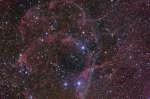
The plane of our Milky Way Galaxy runs through this complex and beautiful skyscape. At the northwestern edge of the constellation Vela (the Sails) the telescopic frame is over 10 degrees wide, centered on the brightest glowing filaments of the Vela Supernova Remnant, an expanding debris cloud from the death explosion of a massive star.
 Aurora on Ice
12.02.2015
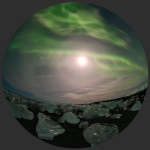
Not from a snowglobe, this expansive fisheye view of ice and sky was captured on February 1, from Jökulsárlón Beach, southeast Iceland, planet Earth. Chunks of glacial ice on the black sand beach glisten in the light of a nearly full moon surrounded by a shining halo.
|
January February March April May June July August September October |
|||||||||||||||||||||||||||||||||||||||||||||||||