
|
You entered: clouds
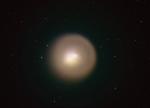 Golden Comet Holmes
3.11.2007
Surprising Comet Holmes remains easily visible as a round, fuzzy cloud in the northern constellation Perseus. Skywatchers with telescopes, binoculars, or those that just decide to look up can enjoy the solar system's latest prodigy as it glides about 150 million kilometers from Earth, beyond the orbit of Mars.
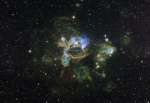 The N44 Complex
27.03.2008
A truly giant complex of emission nebulae, N44 is about 1,000 light-years across. It shines in southern skies as a denizen of our neighboring galaxy, the Large Magellanic Cloud, 170,000 light-years away.
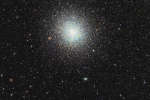 47 Tuc: A Great Globular Cluster of Stars
26.08.2008
Stars come in bunches. Of the over 200 globular star clusters that orbit the center of our Milky Way Galaxy, 47 Tucanae is the second brightest globular cluster (behind Omega Centauri). Light takes about...
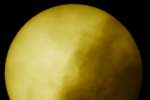 Sunspots on a Cloudy Day
4.06.2009
On June 2nd, clouds over Stuttgart, Germany parted to reveal what has become a relatively rare sight, spots on the Sun. In fact, the roughly 11-year solar activity cycle is still in a surprisingly deep minimum and the years 2008 and 2009 have had the lowest sunspot counts since the 1950s.
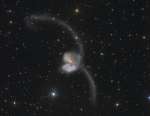 The Antennae
29.04.2011
Some 60 million light-years away in the southerly constellation Corvus, two large galaxies collided. But the stars in the two galaxies, cataloged as NGC 4038 and NGC 4039, don't collide in the course of the ponderous event, lasting hundreds of millions of years.
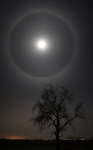 A February Moon Halo
11.02.2012
Lighting the night last Tuesday, February's Full Moon is sometimes called the Snow Moon. But the Moon was not quite full in this mosaicked skyscape recorded on February 2 south of Budapest, Hungary, and there was no snow either.
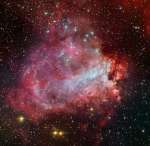 Star Factory Messier 17
22.10.2015
Sculpted by stellar winds and radiation, the star factory known as Messier 17 lies some 5,500 light-years away in the nebula-rich constellation Sagittarius. At that distance, this 1/3 degree wide field of view spans over 30 light-years.
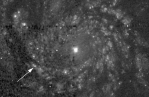 A Supernova in the Whirlpool
21.04.1996
In 1994, a new star in a distant galaxy was seen by amateur astronomers, who alerted the world to their discovery of a supernova. Near the nucleus of spiral galaxy M51, popularly known...
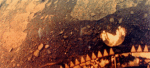 A Venus Landing
27.09.1995
This image is part of the first color panoramic view from Venus. It was transmitted by a TV camera on the Soviet Venera 13 lander which parachuted to the surface on March 1, 1982.
 LMC X-1: A Black Hole Candidate
30.12.1995
The strongest source of X-rays in the Large Magellanic Cloud originates from an unusually energetic binary star system. This strong source, dubbed LMC X-1, is thought to be a normal and compact star orbiting each other. Gas stripped of the normal star falls onto the compact star, heats up, and emits X-rays.
|
January February March April May June July August September October |
|||||||||||||||||||||||||||||||||||||||||||||||||