
|
You entered: clouds
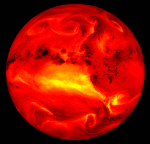 The Water Vapor Channel
12.10.1996
What alien planet's bizarre landscape lurks below these fiery-looking clouds? It's only Planet Earth, of course -- as seen on the Water Vapor Channel. Hourly, images like this one (shown in false color) are brought to you by the orbiting GOES 8 satellite's multi-channel imager.
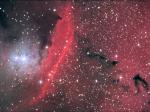 In the Center of NGC 6559
29.06.2004
Bright gas and dark dust permeate the space between stars in the center of a nebula known as NGC 6559. The gas, primarily hydrogen, is responsible for the diffuse red glow of the emission nebula.
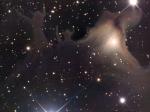 SH2 136: A Spooky Nebula
31.10.2006
The dark nebula SH2-136 appears to be celebrating Halloween all of the time. The complex process of star formation create dust clouds of many shapes and sizes -- it is human perception that might identify a ghoulish creature, on the right of the above image, chasing humans.
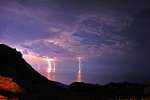 Lightning Eclipse from the Planet of the Goats
18.06.2011
Thunderstorms almost spoiled this view of the spectacular June 15 total lunar eclipse. Instead, storm clouds parted for 10 minutes during the total eclipse phase and lightning bolts contributed to the dramatic sky. Captured...
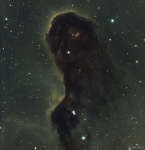 The Dust Monster in IC 1396
2.08.2017
Is there a monster in IC 1396? Known to some as the Elephant's Trunk Nebula, parts of gas and dust clouds of this star formation region may appear to take on foreboding forms, some nearly human. The only real monster here, however, is a bright young star too far from Earth to hurt us.
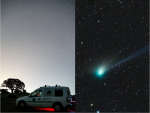 Naked Eye Comet ZTF
21.01.2023
Comet C/2022E3 (ZTF) is no longer too dim to require a telescope for viewing. By January 19, it could just be seen with the naked eye in this rural sky with little light pollution from a location about 20 kilometers from Salamanca, Spain.
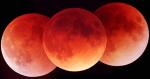 A Lunar Eclipse in Three Exposures
25.01.2000
Our Moon turned red last week. The reason was that during the night of January 20, a total lunar eclipse occurred. The above digitally superimposed photographs captured the Moon three times during this lunar...
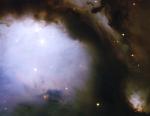 Reflection Nebula M78
11.02.2002
An eerie blue glow and ominous columns of dark dust highlight M78, one of the brightest reflection nebula on the sky. M78 is visible with a small telescope toward the constellation of Orion. The dust not only absorbs light, but also reflects the light of several bright blue stars that formed recently in the nebula.
 Clearing Skies
26.07.2002
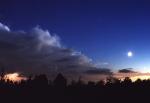
Clear evening skies are a welcome sight for stargazers worldwide, but clearing skies are good too. Just such a glorious occasion was recorded in this dramatic photo taken by Dominic Cantin during a recent gathering of Canadian astronomers at St-NИrИe Observatory, located about 60 kilometers southeast of the city of Quebec.
 The UV SMC from UIT
20.12.1996
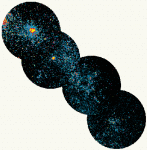
Translated from the "acronese" the title reads - The UltraViolet Small Magellanic Cloud from the Ultraviolet Imaging Telescope. FYI, the four ultraviolet images used in this mosaic of the nearby irregular galaxy known...
|
January February March April May June July August September October |
|||||||||||||||||||||||||||||||||||||||||||||||||