
|
You entered: color
 The Last Panorama of the Spirit Rover on Mars
30.05.2011
This is the last thing that the Spirit rover on Mars ever saw. Operating years beyond original expectations, Spirit eventually got mired in martian dirt and then ran out of power when investigating the unusual Home Plate surface feature on Mars.
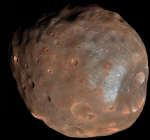 Phobos: Doomed Moon of Mars
28.10.2012
This moon is doomed. Mars, the red planet named for the Roman god of war, has two tiny moons, Phobos and Deimos, whose names are derived from the Greek for Fear and Panic. These...
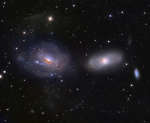 Unraveling NGC 3169
28.03.2013
Bright spiral galaxy NGC 3169 appears to be unraveling in this cosmic scene, played out some 70 million light-years away just below bright star Regulus toward the faint constellation Sextans. Its beautiful spiral arms...
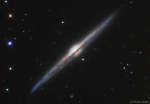 NGC 4565: Galaxy on Edge
24.05.2017
Is our Galaxy this thin? We believe so. Magnificent spiral galaxy NGC 4565 is viewed edge-on from planet Earth. Also known as the Needle Galaxy for its narrow profile, bright NGC 4565 is a stop on many telescopic tours of the northern sky, in the faint but well-groomed constellation Coma Berenices.
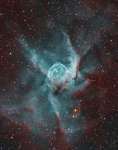 NGC 2359: Thor s Helmet
16.02.2019
NGC 2359 is a helmet-shaped cosmic cloud with wing-like appendages popularly called Thor's Helmet. Heroically sized even for a Norse god, Thor's Helmet is about 30 light-years across. In fact, the helmet...
 Enhanced: The Dolphin Cloud on Jupiter
15.04.2019
Do you see the dolphin-shaped cloud on Jupiter? The cloud was visible last year during perijove 16, the sixteenth time that NASA's robotic spacecraft Juno passed near Jupiter since it arrived in mid-2016. During each perijove, Juno passes near a slightly different part of Jupiter's cloud tops.
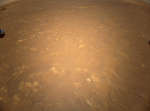 Perseverance from Ingenuity
1.05.2021
Flying at an altitude of 5 meters (just over 16 feet), on April 25 the Ingenuity helicopter snapped this sharp image. On its second flight above the surface of Mars, its color camera was looking back toward Ingenuity's current base at Wright Brothers Field and Octavia E.
 APOD: 2025 May 27 Б Zeta and Rho Ophiuchi with Milky Way
27.05.2025
Behold one of the most photogenic regions of the night sky, captured impressively. Featured, the band of our Milky Way Galaxy runs diagonally along the bottom-left corner, while the colorful Rho Ophiuchi cloud complex is visible just right of center and the large red circular Zeta Ophiuchi Nebula appears near the top.
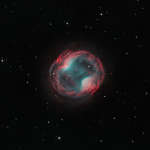 APOD: 2026 May 27 Б PK 164 +31.1: The Headphone Nebula
27.05.2026
What is a pair of headphones doing in the sky? TodayБs image features the Headphone Nebula, also known as PK 164 +31.1 or Jones-Emberson 1. This planetary nebula, the remnant of a dying Sun-like star, faintly occupies an angular region of the Lynx constellation about 1/5 th the diameter of the full moon.
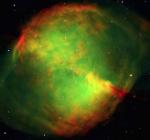 M27: Not A Comet
2.03.2002
While searching the skies above 18th century France for comets, astronomer Charles Messier diligently recorded this object as number 27 on his list of things which are definitely not comets. So what is it?
|
January February March April May June July August September October |
|||||||||||||||||||||||||||||||||||||||||||||||||