
|
You entered: color
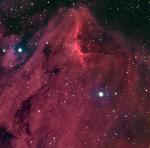 The Pelican in the Swan
29.08.2002
The Pelican Nebula, also known as IC 5070, lies about 2,000 light-years away in the high and far-off constellation of Cygnus, the Swan. This picture spans a portion of the magnificent nebula about 30 light-years wide.
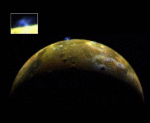 Galileo Views Io Eruption
15.08.1996
Io's surface is active. Geyser-like eruptions from volcanoes on this Jovian moon were seen by both Voyager spacecraft in 1979 and were also spotted this year in late June by Galileo's camera from a distance of about 600,000 miles.
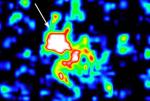 A GRB Host?
25.06.1997
Where do gamma-ray bursts (GRBs) originate? The most powerful explosions in the universe have recently been located with record accuracy. But do GRBs occur in galaxies or out alone in deep space? This picture taken with the Hubble Space Telescope of the field surrounding GRB 970228 might provide a clue.
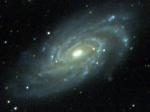 NGC 6070: First Light for Sloan
10.06.1998
The graceful spiral galaxy NGC 6070, 100 million light-years distant in the constellation Serpens, is helping astronomers celebrate "First Light" (the first test sky images) for an exciting new telescope built to perform the ambitious Sloan Digital Sky Survey.
 Massive Star Forming Region DR21 in Infrared
14.04.2004
Deep in the normally hidden recesses of giant molecular cloud DR21, a stellar nursery has been found creating some of the most massive stars yet recorded. The orbiting Spitzer Space Telescope's Infrared Array Camera opened the window into the cloud last year in mid- infrared light.
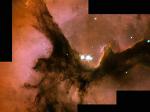 The Trifid Nebula from Hubble
18.06.2004
Clouds of glowing gas mingle with lanes of dark dust in the Trifid Nebula, a star forming region toward the constellation of Sagittarius. In the center, the three huge dark dust lanes that give the Trifid its name all come together.
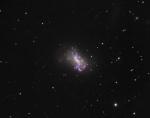 Small Galaxy NGC 4449
3.05.2007
Grand spiral galaxies often seem to get all the glory. Their newly formed, bright, blue star clusters along beautiful, symmetric spiral arms are guaranteed to attract attention. But small irregular galaxies form stars too, like NGC 4449, located about 12 million light-years away.
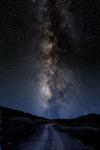 The Milky Road
20.10.2007
Inspired during a visit to Fort Davis, Texas, home of McDonald Observatory and dark night skies, photographer Larry Landolfi created this tantalizing fantasy view. The composited image suggests the Milky Way is a heavenly extension of a deserted country road.
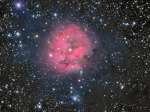 IC 5146: The Cocoon Nebula
27.08.2008
Inside the Cocoon Nebula is a newly developing cluster of stars. Cataloged as IC 5146, the beautiful nebula is nearly 15 light-years wide, located some 4,000 light years away toward the northern constellation Cygnus.
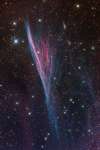 NGC 2736: The Pencil Nebula
8.01.2009
This shock wave plows through space at over 500,000 kilometers per hour. Moving right to left in the beautifully detailed color composite, the thin, braided filaments are actually long ripples in a sheet of glowing gas seen almost edge on. Cataloged as NGC 2736, its narrow appearance suggests its popular name, the Pencil Nebula.
|
January February March April May June July August September October |
|||||||||||||||||||||||||||||||||||||||||||||||||