
|
You entered: Sun
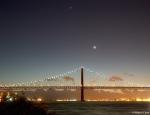 Lisbon Moonset
24.03.2007
Brilliant Venus, a slender crescent Moon, and lights along the Ponte 25 de Abril glow against the western twilight in this lovely moonset scene from Lisbon, Portugal, recorded on March 20. In fact, such...
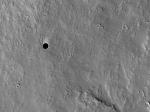 A Hole in Mars
28.05.2007
Black spots have been discovered on Mars that are so dark that nothing inside can be seen. Quite possibly, the spots are entrances to deep underground caves capable of protecting Martian life, where it to exist. The unusual hole pictured above was found on the slopes of the giant Martian volcano Arsia Mons.
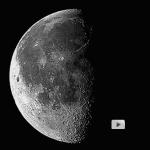 Lunation
2.09.2007
Our Moon's appearance changes nightly. This time-lapse sequence shows what our Moon looks like during a lunation, a complete lunar cycle. As the Moon orbits the Earth, the half illuminated by the Sun first becomes increasingly visible, then decreasingly visible. The Moon always keeps the same face toward the Earth.
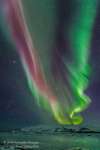 Orion and Aurora over Iceland
24.03.2014
If you see a sky like this -- photograph it. A month ago in Iceland, an adventurous photographer (pictured) chanced across a sky full of aurora and did just that. In the foreground lies the stratovolcano жrФfajЖkull. In the background, among other sky delights, lies the constellation of Orion, visible to the aurora's left.
 Pluto at Night
20.10.2019
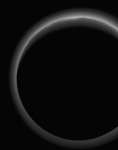
The night side of Pluto spans this shadowy scene, a stunning spacebased view with the Sun 4.9 billion kilometers (almost 4.5 light-hours) behind the dim and distant world. It was captured by far flung New Horizons in July of 2015.
 Pluto at Night
26.03.2022
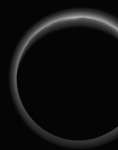
The night side of Pluto spans this shadowy scene. In the stunning spacebased perspective the Sun is 4.9 billion kilometers (almost 4.5 light-hours) behind the dim and distant world. It was captured...
 APOD: 2024 March 24 Б Looking Back at an Eclipsed Earth
24.03.2024
Here is what the Earth looks like during a solar eclipse. The shadow of the Moon can be seen darkening part of Earth. This shadow moved across the Earth at nearly 2000 kilometers per hour.
 Pluto at Night
16.11.2024
The night side of Pluto spans this shadowy scene. In the stunning spacebased perspective the Sun is 4.9 billion kilometers (almost 4.5 light-hours) behind the dim and distant world. It was captured...
 A Giant Starspot on HD 12545
12.07.2000
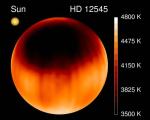
What could cause a star to have such a large spot? Our Sun itself frequently has sunspots, relatively cool dark magnetic depressions that move across its surface. HD 12545, however, exhibits the largest starspots yet observed.
 The Hubble 5 Planetary Nebula
19.01.1998
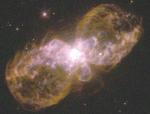
The Hubble Double Bubble Planetary Nebula is bubbling over with excitement. More mundanely known as Hubble 5, this bipolar planetary nebula is being created by a hot wind of particles streaming away from the central star system.
|
January February March April May June July August September October |
|||||||||||||||||||||||||||||||||||||||||||||||||