
|
You entered: Sun
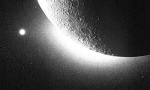 Sunshine, Earthshine at the Lunar Limb
30.05.1996
This dramatic image of the Moon's edge against a background of distant stars is from a perspective impossible for groundbased telescopes. It was taken by a star tracker camera onboard the Clementine spacecraft.
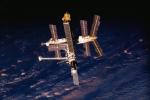 A Mirry Christmas
24.12.1996
Thinking about spending the Holiday Season in low Earth orbit? Astronaut John Blaha and his cosmonaut colleagues Valeri Korzun and Alexander Kaleri are doing just that onboard the Russian Mir spacestation. You can e-mail them Seasons Greetings.
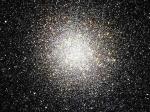 Globular Cluster M22 from CFHT
27.06.2005
The globular cluster M22, pictured above, contains over 100,000 stars. These stars formed together and are gravitationally bound. Stars orbit the center of the cluster, and the cluster orbits the center of our Galaxy. So far, about 140 globular clusters are known to exist in a roughly spherical halo around the Galactic center.
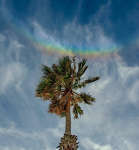 When Rainbows Smile
11.03.2022
Want to see a rainbow smile? Look near the zenith (straight up) when the sun is low in the sky and you might. This example of an ice halo known as a circumzenithal arc was captured above a palm tree top from Ragusa, Sicily on February 24.
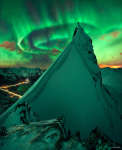 APOD: 2023 January 22 Б In Green Company: Aurora over Norway
22.01.2023
Raise your arms if you see an aurora. With those instructions, two nights went by with, well, clouds -- mostly. On the third night of returning to same peaks, though, the sky not only cleared up but lit up with a spectacular auroral display.
 Mars and the Beehive
10.06.2023
This month, bright Mars and brilliant Venus are the prominent celestial beacons in planet Earth's western skies after sunset. Wandering through the constellation Cancer the Crab, the Red Planet was captured here on the evening of June 3 near the stars of open cluster Messier 44.
 Alnitak, Alnilam, Mintaka
20.11.2025
Alnitak, Alnilam, and Mintaka are the bright bluish stars from east to west (upper right to lower left) along the diagonal in this cosmic vista. Otherwise known as the Belt of Orion, these three blue supergiant stars are hotter and much more massive than the Sun.
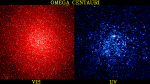 Globular Cluster Omega Centauri
4.10.1996
Does an old, red globular cluster have any hot, blue stars? The rightmost picture, taken by the Ultraviolet Imaging Telescope in ultraviolet light, shows that indeed it does. Pictured, Omega Centauri is the largest known globular cluster in our Galaxy, containing well over a million stars.
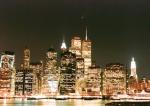 Comet Hale-Bopp Over New York City
8.04.1997
What's that point of light above the World Trade Center? It's Comet Hale-Bopp! Both faster than a speeding bullet and able to "leap" tall buildings in its single orbit, Comet Hale-Bopp is also bright enough to be seen even over the glowing lights of one of the world's premier cities.
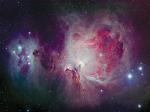 The Great Nebula in Orion
27.09.2004
The Great Nebula in Orion is a colorful place. Visible to the unaided eye, it appears as a small fuzzy patch in the constellation of Orion. Long exposure, digitally sharpened images like this, however, show the Orion Nebula to be a busy neighborhood of young stars, hot gas, and dark dust.
|
January February March April May June July August September October |
|||||||||||||||||||||||||||||||||||||||||||||||||