
|
You entered: sky
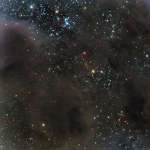 Chamaeleon II Dark Cloud
2.08.2019
A small constellation hiding near the south celestial pole, The Chamaeleon boasts no bright stars. Stars are forming within its constellation boundaries though, in a complex of dark, dusty molecular clouds. Some 500 light-years...
 APOD: 2025 July 18 Б ISS Meets Saturn
18.07.2025
This month, bright planet Saturn rises in evening skies, its rings oriented nearly edge-on when viewed from planet Earth. And in the early morning hours on July 6, it posed very briefly with the International Space Station when viewed from a location in Federal Way, Washington, USA.
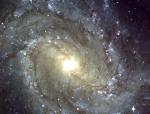 M83: The Southern Pinwheel Galaxy from VLT
11.05.2003
M83 is one of the closest and brightest spiral galaxies on the sky. Visible with binoculars in the constellation of Hydra, majestic spiral arms have prompted its nickname as the Southern Pinwheel. Although discovered...
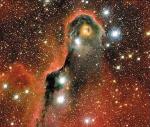 An Unusual Globule in IC 1396
19.10.2003
Is there a monster in IC 1396? Known to some as the Elephant's Trunk Nebula, parts of gas and dust clouds of this star formation region may appear to take on foreboding forms, some nearly human. The only real monster here, however, is a bright young star too far from Earth to hurt us.
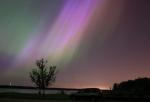 Aurora Iowa
20.05.2005
Early last Sunday morning stars were not the only lights in Iowa skies. The northern lights also shone from the heavens, extending across the midwestern USA and other locations not often graced with auroral displays.
 The Antikythera Mechanism
5.12.2006
What is it? It was found at the bottom of the sea aboard an ancient Greek ship. Its seeming complexity has prompted decades of study, although many of its functions remained unknown. Recent X-rays of the device have now confirmed the nature of the Antikythera mechanism, and discovered several surprising functions.
 Hungarian Spring Eclipse
4.05.2013
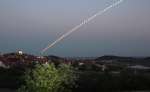
Last week, as the Sun set a Full Moon rose over the springtime landscape of Tihany, Hungary on the northern shores of Lake Balaton. As it climbed into the clear sky, the Moon just grazed the dark, umbral shadow of planet Earth in the year's first partial lunar eclipse.
 Aurora and Volcanic Light Pillar
23.09.2014
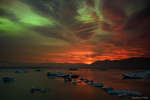
That's no sunset. And that thin red line just above it -- that's not a sun pillar. The red glow on the horizon originates from a volcanic eruption, and the red line is the eruption's reflection from fluttering atmospheric ice crystals. This unusual volcanic light pillar was captured over Iceland earlier this month.
 Venus and Mercury at Sunset
14.01.2015
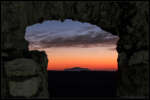
Inner planets Venus and Mercury can never wander far from the Sun in Earth's sky. This week you've probably seen them both gathered near the western horizon just after sunset, a close conjunction of bright celestial beacons in the fading twilight.
 Carina Nebula Dust Pillar
7.02.2015
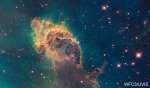
This cosmic pillar of gas and dust is nearly two light-years wide. The structure lies within one of our galaxy's largest star forming regions, the Carina Nebula, shining in southern skies at a distance of about 7,500 light-years.
|
January February March April May June July August September October |
|||||||||||||||||||||||||||||||||||||||||||||||||