
|
You entered: sky
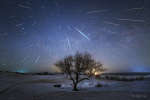 Gemini s Meteors
22.12.2017
From dark skies above Heilongjiang province in northeastern China, meteors rain down on a wintry landscape in this beautiful composited night scene. The 48 meteors are part of last week's annual Geminid meteor shower.
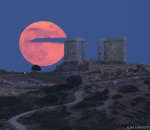 Strawberry Moon over the Temple of Poseidon
18.06.2019
Did you see the full moon last night? If not, tonight's nearly full moon should be almost as good. Because full moons are opposite the Sun, they are visible in the sky when the Sun is not -- which should be nearly all night long tonight, clouds permitting.
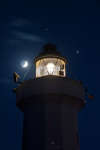 Great Conjunction over Sicilian Lighthouse
8.12.2020
DonБt miss the coming great conjunction. In just under two weeks, the two largest planets in our Solar System will angularly pass so close together in Earth's sky that the Moon would easily be able to cover them both simultaneously. This pending planetary passage -- on December 21 -- will be the closest since 1623.
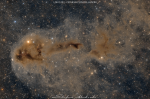 Lynds Dark Nebula 1251
24.11.2022
Stars are forming in Lynds Dark Nebula (LDN) 1251. About 1,000 light-years away and drifting above the plane of our Milky Way galaxy, the dusty molecular cloud is part of a complex of dark nebulae mapped toward the Cepheus flare region.
 183 Days in the Sun
22.12.2023
A single 183 day exposure with a pinhole camera and photographic paper resulted in this long-duration solargraph. Recorded from solstice to solstice, June 21 to December 21, in 2022, it follows the Sun's daily arcing path through planet Earth's skies from Mertola, Portugal.
 Neptune at Night
9.11.2024
Ice giant Neptune is faint in Earth's night sky. Some 30 times farther from the Sun than our fair planet, telescopes are needed to catch a glimpse of the dim and distant world. This dramatic view of Neptune's night just isn't possible for telescopes in the vicinity of planet Earth though.
 APOD: 2025 February 4 Б Anticrepuscular Rays: A Rainbow Fan over Spain
4.02.2025
Yes, but can your rainbow do this? Late in the day, the Sun set as usual toward the west. However, on this day, the more interesting display was 180 degrees around -- toward the east. There, not only was a rainbow visible, but an impressive display of anticrepuscular rays from the rainbow's center.
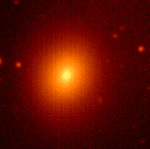 Dwarf Elliptical Galaxy M32
6.01.1996
Being the largest galaxy around can sometimes make you popular. Pictured is M31's companion galaxy M32. M31, the Andromeda galaxy, is the largest galaxy in our Local Group of galaxies - even our tremendous Milky Way Galaxy is smaller.
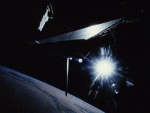 The Equal Night
22.09.1996
Today the Sun crosses the celestial equator heading south -- marking the Autumnal Equinox, the first day of Autumn. Equinox means equal night and with the Sun on the celestial equator, Earthlings will experience 12 hours of daylight and 12 hours of darkness.
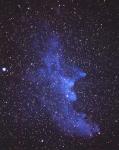 The Witch Head Nebula
29.08.1999
Double, double toil and trouble; Fire burn, and cauldron bubble ... Maybe Macbeth should have consulted the Witch Head Nebula. This suggestively shaped reflection nebula is associated with the bright star Rigel in the constellation Orion. More formally known as IC 2118, the Witch Head Nebula glows primarily by light reflected from Rigel.
|
January February March April May June July August September October |
|||||||||||||||||||||||||||||||||||||||||||||||||