
|
You entered: space
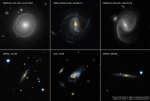 Spiral Galaxies Spinning Super Fast
5.11.2019
Why are these galaxies spinning so fast? If you estimated each spiral's mass by how much light it emits, their fast rotations should break them apart. The leading hypothesis as to why these galaxies don't break apart is dark matter -- mass so dark we can't see it.
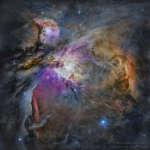 Orion Nebula: The Hubble View
29.06.2021
Few cosmic vistas excite the imagination like the Orion Nebula. Also known as M42, the nebula's glowing gas surrounds hot young stars at the edge of an immense interstellar molecular cloud only 1,500 light-years away.
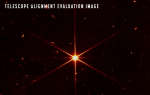 2MASS J17554042 6551277
19.03.2022
2MASS J17554042+6551277 doesn't exactly roll off the tongue but that's the name, a coordinate-based catalog designation, of the star centered in this sharp field of view. Fans of the distant universe should get used to its spiky appearance though.
 APOD: 2023 December 6 Б Stars Verus Dust in the Carina Nebula
6.12.2023
It's stars versus dust in the Carina Nebula and the stars are winning. More precisely, the energetic light and winds from massive newly formed stars are evaporating and dispersing the dusty stellar nurseries in which they formed.
 APOD: 2025 April 9 Б HH 49: Interstellar Jet from Webb
9.04.2025
What's at the tip of this interstellar jet? First let's consider the jet: it is being expelled by a star system just forming and is cataloged as Herbig-Haro 49 (HH 49). The star system expelling this jet is not visible -- it is off to the lower right.
 APOD: 2025 May 26 Б Spiral Galaxy NGC 2566 from Webb
26.05.2025
WhatБs happening in the center of spiral galaxy NGC 2566? First, the eight rays that appear to be coming out of the center in the featured infrared image are not real Б they are diffraction spikes caused by the mechanical structure of the Webb space telescope itself.
 APOD: 2025 August 1 Б Small Dark Nebula
1.08.2025
A small, dark, nebula looks isolated near the center of this telescopic close-up. The wedge-shaped cosmic cloudlet lies within a relatively crowded region of space though. About 7,000 light-years distant and filled with glowing gas and an embedded cluster of young stars, the region is known as M16 or the Eagle Nebula.
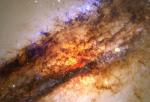 The Center of Centaurus A
22.05.1998
A fantastic jumble of young blue star clusters, gigantic glowing gas clouds, and imposing dark dust lanes surrounds the central region of the active galaxy Centaurus A. This mosaic of Hubble Space Telescope images taken in blue, green, and red light has been processed to present a natural color picture of this cosmic maelstrom.
 A Quasar-Galaxy Collision?
22.10.1995
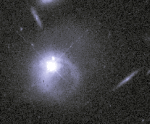
In 1963 astronomers were astounded to discover that certain faint, star-like objects have very large redshifts. The large redshifts imply that these objects, now known as quasars (QUASi-stellAR objects), lie near the edge of the observable Universe.
 A High Energy Fleet
25.02.1996
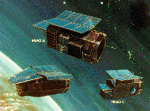
Looking like a fleet of futuristic starcruisers poised over planet Earth, NASA's highly successful series of High Energy Astrophysical Observatory (HEAO) spacecraft appear above in a vintage illustration. Labeled A, B, and C in this conceptual picture, the spacebased telescopes were known as HEAO-1, HEAO-2, and HEAO-3 respectively.
|
January February March April May June July August September October |
|||||||||||||||||||||||||||||||||||||||||||||||||