
|
You entered: space
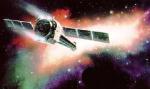 Name This Satellite
20.04.1998
Can you name this satellite? In December, NASA's third Great Observatory is planned for launch. The two NASA Great Observatories currently in orbit are the Hubble Space Telescope and the Compton Gamma-Ray Observatory, both now named for famous scientists. But after whom should the Advanced X-ray Astrophysics Facility (AXAF) be named?
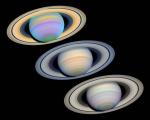 Saturn by Three
18.09.2003
These three views of Saturn were recorded by the Hubble Space Telescope on March 7th of this year, as the southern hemisphere of the solar system's most gorgeous planet reached its maximum 27 degree tilt toward Earth.
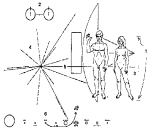 Greetings from the Pioneers
30.06.1996
Launched in the early 1970s Pioneer 10 and 11 were appropriately named - becoming the first spacecraft to travel through the asteroid belt, first to fly by Jupiter and Saturn, and the first human artifacts to venture beyond the solar system.
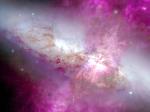 The Supergalactic Wind from Starburst Galaxy M82
1.06.2004
Star formation occurs at a faster pace in M82 -- a galaxy with about ten times the rate of massive star birth (and death) compared to our Milky Way. Winds from massive stars and blasts from supernova explosions have created a billowing cloud of expanding gas from this remarkable starburst galaxy.
 Spiral Eddies On Planet Earth
16.01.1999
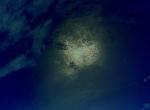
Can you identify this wispy stellar nebula? How many light-years from Earth did you say? Resembling a twisting cloud of gas and dust between the stars this swirling form is actually close by - a spiral eddy formed near the North Atlantic Gulf Stream off the East coast of the U. S.
 RCW 79: Stars in a Bubble
15.04.2005
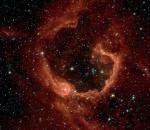
A cosmic bubble of gas and dust, RCW 79 has grown to about 70 light-years in diameter, blown by the winds and radiation from hot young stars. Infrared light from the dust embedded in the nebula is tinted red in this gorgeous false-color view from the Spitzer Space Telescope.
 Io Shadow
23.04.1999
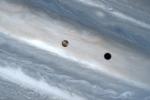
Orbiting Jupiter once every 43 hours, the volcanic moon Io cruises 500,000 kilometers above swirling, banded cloud-tops. Orbiting Earth once every 1.5 hours, the Hubble Space Telescope watched as Io accompanied by its shadow crossed the face of the reigning gas giant planet in 1997.
 Ceres: Asteroid or Planet
21.08.2006
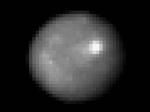
Is Ceres an asteroid or a planet? Although a trivial designation to some, the recent suggestion by the Planet Definition Committee of the International Astronomical Union would have Ceres reclassified from asteroid to planet. A change in taxonomy might lead to more notoriety for the frequently overlooked world.
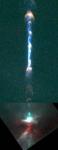 HH111's 12 Light-Year Star Jet
21.03.2000
The complex interactions of three stars in the Orion B molecular cloud complex have resulted in the ejection of particles along a 12 light-year long jet. One of the stars in the HH111 system has apparently also been ejected leaving two stars tightly bound in a binary orbit.
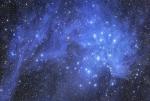 Pleiades and Stardust
22.11.2007
Hurtling through a cosmic dust cloud a mere 400 light-years away, the lovely Pleiades or Seven Sisters star cluster is well-known for its striking blue reflection nebulae. This remarkable wide-field (3 degree) image...
|
January February March April May June July August September October |
|||||||||||||||||||||||||||||||||||||||||||||||||